



TimeLine Antiquities & Ancient Art Auction on March 3-4
Britain’s TimeLine Auctions will host a curated series of sales in early March 2026. The featured events are a March 3-4 Ancient Art, Antiquities, Collectables & Natural History Auction and a March 10-11 auction replete with Ancient Coins, Weights, Tokens, Medals, Books and a special selection of Roman gemstones from an English private collection. All auction lots can be viewed online, while items offered during the opening day of each sale are also shown in TimeLine’s printed catalogues. Both the online and print editions of the catalogue include detailed descriptions and photographs of each item from multiple angles, as well as the object’s line of provenance (record of former ownership).
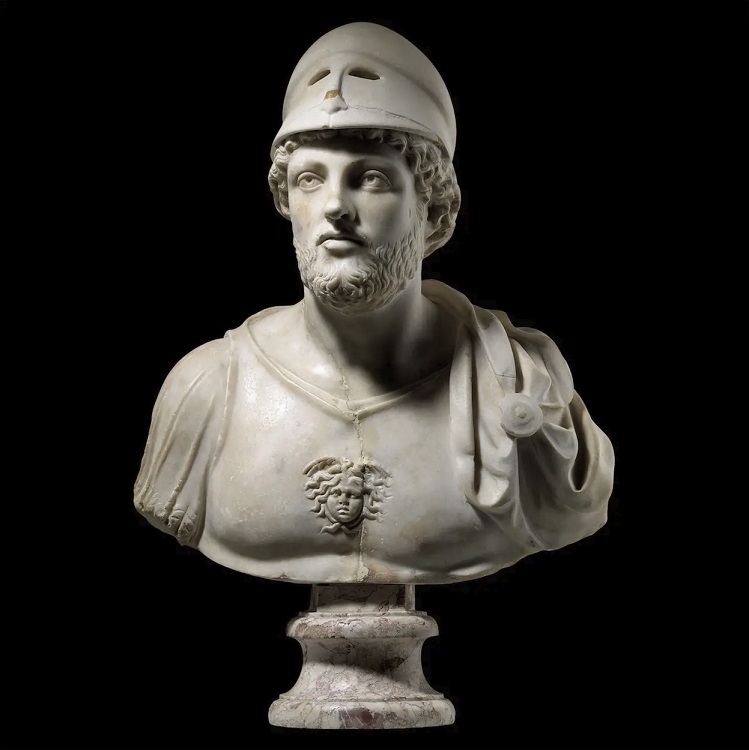
Opening day, March 3, might well be called “Face Time,” as it features examples of Ancient Roman visages in marble, stone, and other materials of the period. A late 4th century AD Roman marble bust of Mars depicts the God of War with a calm, idealized facial expression with heavily-lidded eyes, a neatly trimmed beard, and wavy hair crowned by a Corinthian helmet. He wears a cuirass adorned with a small gorgoneion, and a chlamys secured by a brooch on the left shoulder. This artwork stands 27 inches tall, weighs 45.2kg, and bears characteristics reminiscent of a sculpted female head in the Vatican. Estimate: $40,500-$54,450/£30,000-£40,000
Sarcophagus production was an active industry in the Roman Imperial period, with coffins frequently sold “ready-made” with standard decorative schemes. The auction features a circa 135 A.D. panel whose Hadrianic date places it within the peak period of garland sarcophagi production in Roman Italy. Coming from the right end of an ornate sarcophagus, it is centered with a carved, dramatic theatrical mask with an open mouth and drilled eyes, the forehead morticed for an attachment. To its left, a winged depiction of Eros (Greek God of Love) supports a heavy garland of oak leaves and acorns. A boukranion (ox skull) appears to the right. Most recently in a New York City private collection, it was previously with Christie’s (1995 and 2019) and Sotheby’s (2020). Its auction estimate is $24,255-$32,340/£18,000-£24,000.
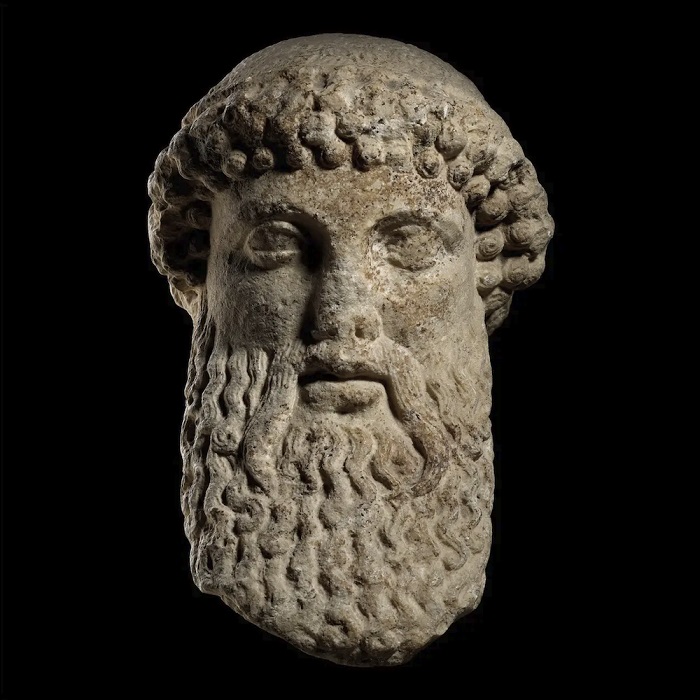
A life-size head of Hermes is a Roman copy of a 5th century BC Greek type known as “Hermes Propylaios” attributed to Attic sculptor Alkamenes, a pupil of Phidias. The subject’s beard is tiered and closely curled, and the front of the head is worked with care and clarity, both indicative of the Roman workshop method. Some theories say such depictions of Hermes were created for the Propylaea of the Acropolis of Athens, Hermes being the patron deity of doors and entrances. With provenance from Chaucer Fine Arts Ltd, 1980s; and an English private collection, it comes with an academic report by Dr. Marina Mattei and Dr. Laura Maria Vigna. Opening bid: $20,093/£14,870
Three times life-size, a 1st-2nd century AD Roman head of the goddess Diana has sensual lips, deep eyes and hair styled in transverse braids across the brow with a laurel wreath above the forehead. This architectural element, 28-3/8in (inclusive of custom display stand), would have supported the sima of a building of great size. Provenance includes a private Belgian collection, the Madame Andree Mace collection; and an English private collection. Accompanied by an academic report by Professor Neritan Ceka, its opening bid is $8,037/£6,000.
A large lower section of a 2nd century AD Roman marble figure of the goddess Isis includes a floor-length robe and sandaled right foot, and is modeled in a standing pose with the foot slightly advanced. Its height is 19-5/8in and it weighs 66.65kg. Its modern line of provenance can be traced to an American private collection (1980s-1990s), with a 2020 auction appearance at Sotheby’s in London. Similar statuary can be seen in Mark Fullerton’s 1990 book The Archaistic Style in Roman Statuary. Estimate: $9,430-$12,130/£7,000-£9,000
The marble head of a youthful Eros, Greek God of Love, was sculpted in 2nd-3rd century AD Rome. Carved in the round as a bust of a curly-haired child with a youthful face, wide cheeks, slightly opened mouth with full lips, and almond-shape eyes, it measures 13-1/2 inches tall (inclusive of custom stand). The piece was held in the private collection of Mr. and Mrs. A at their mansion near the Champs-Élysées in Paris; thence by descent; followed by acquisition on the French art market; and a private collection in England. It can be compared to an artwork in The British Museum, Number 1879,0712.7. It has an auction opening bid of $8,037/£6,000.
A London private collection is the source of an assemblage of Ancient Roman gemstones serving as a special highlight of TimeLine’s March 10-11 auction of Ancient Coins, et al. Animal subjects, which were favored in all manner of Roman artworks from the 2nd century BC through 4th century AD, are boldly represented in several top pieces.
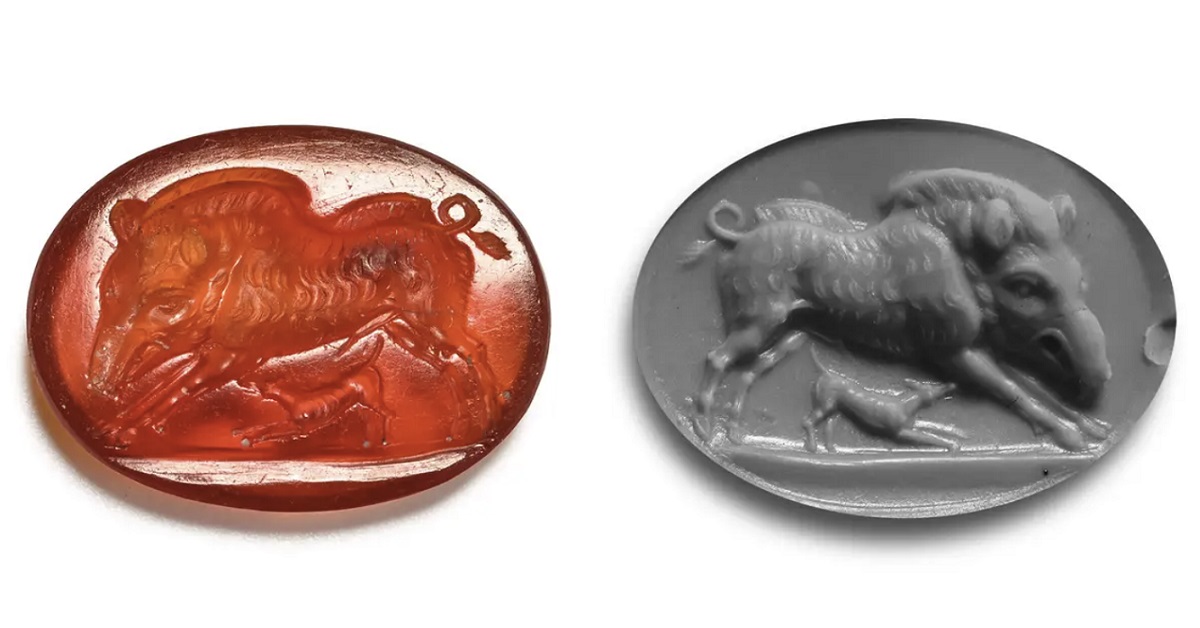
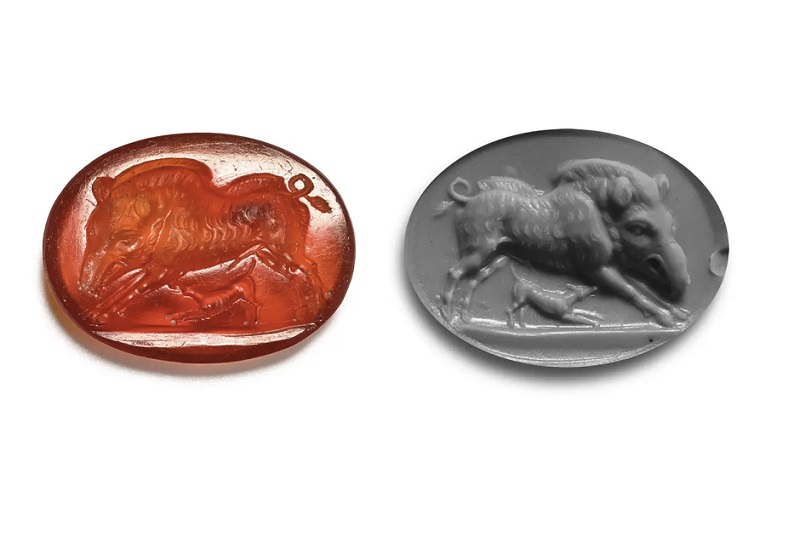
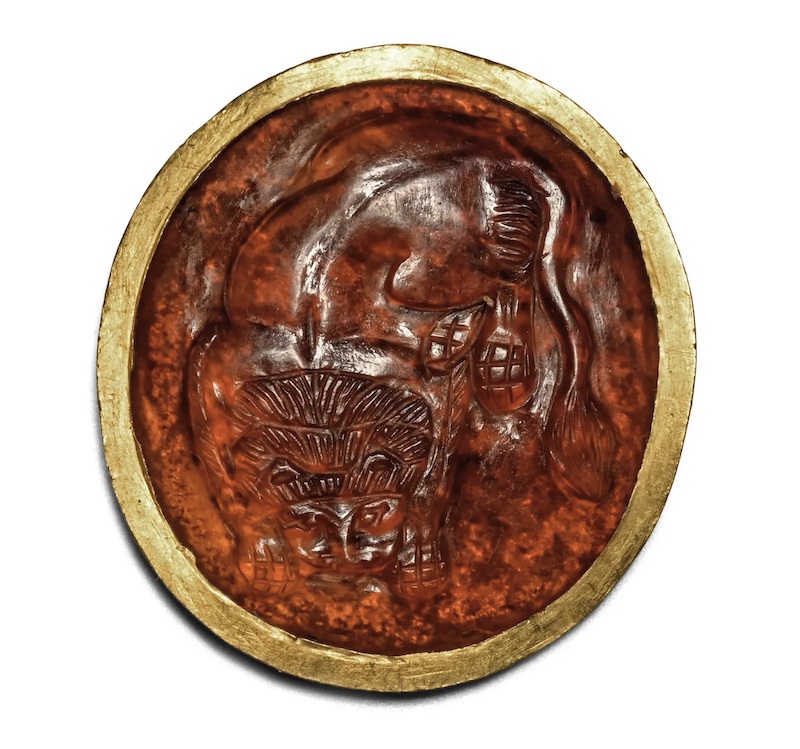
An Eastern Roman carnelian cameo from the 3rd-4th century AD has an inset convex gemstone depicting a crouching lion with his head resting on his forepaws. The attractive discoid-form cell is secured in a gold mount with a flange rim. Prior to joining the London collection, this handsome specimen was previously part of an English private collection formed between the late 1970s and early 1990s. Its pre-sale estimate is £3,000-£4,000. Also reflecting the wild kingdom, a Roman carnelian gemstone from the 1st century BC to 1st century AD is fashioned in an ellipsoid shape and carved with a scene of a hunting dog attacking a large running boar. Estimate: £2,000-£3,000
A late 1st century BC Roman aquamarine gemstone of a philosopher portrays an elderly man wearing a tunic and toga. It will convey to its new owner with a museum-quality impression of the artwork. Estimate: £2,000-£3,000. As history shows, not all Ancient Roman figures were honorable or noble. Accordingly, even uncouth characters found their way into gems of the period, like the auction’s agate cameo of a theatrical mask depicting “Pornoboskos.” A stock character in New Comedy, the unsavory Pornoboskos was a brothel-keeper who often played the adversary to love-struck young protagonists. Created in the 1st century BC, the cameo in his image includes such features as a bushy beard, pronounced eyebrows and crazed eyes. Estimate: £1,000-£1,400
From the demonic to the divine, a Graeco-Roman sard gemstone of the god Apollo, 2nd-1st century BC, is set in a later Roman Period gold mount with a roped border and attachment loop at the top. Masterfully carved, it features an intaglio profile bust of a youthful male with curly hair, wearing a headdress. Relevant information regarding this type of intaglio is found in AB Chadour’s Rings: The Alice and Louis Koch Collection, Volume I, Leeds, 1994, Item 222. Offered together with a museum-quality impression, this gemstone is expected to sell for £1,200-£1,700. Bearing an instantly recognizable image, a Roman carnelian intaglio gemstone is carved with the bust of Asclepius, God of Medicine, holding a serpent in one hand. Dating to the 1st century AD and accompanied by a museum-quality impression, its auction estimate is £1,000-£1,400.
TimeLine’s Ancient Art, Antiquities, Collectables & Natural History Auction and Coins, Weights, Tokens, Medals & Books Auction Featuring Roman Gemstones will be held live at the company’s head office located at The Court House, 363 Main Road, Harwich, Essex CO12 4DN, UK. All lots featured in TimeLine’s hardcover catalogues will be auctioned during the opening day of each respective sale. Internet bidders may pre-register online. Goods may be previewed in person at the gallery by prior arrangement only.
The auction start time is 8 AM ET US/1 PM GMT each day. All remote forms of bidding are available, including absentee, by phone (book phone line 48 hours ahead of time), or live online through TimeLine’s bidding platform or LiveAuctioneers. TimeLine Auctions accepts payments in GBP and ships worldwide. Questions can be addressed by calling +44 7494 866514 or emailing Aaron Hammond at ah@timelineauctions.com.

Popular Topics
Overstreet Access Quick Links
TimeLine Antiquities & Ancient Art Auction on March 3-4
Britain’s TimeLine Auctions will host a curated series of sales in early March 2026. The featured events are a March 3-4 Ancient Art, Antiquities, Collectables & Natural History Auction and a March 10-11 auction replete with Ancient Coins, Weights, Tokens, Medals, Books and a special selection of Roman gemstones from an English private collection. All auction lots can be viewed online, while items offered during the opening day of each sale are also shown in TimeLine’s printed catalogues. Both the online and print editions of the catalogue include detailed descriptions and photographs of each item from multiple angles, as well as the object’s line of provenance (record of former ownership).
Opening day, March 3, might well be called “Face Time,” as it features examples of Ancient Roman visages in marble, stone, and other materials of the period. A late 4th century AD Roman marble bust of Mars depicts the God of War with a calm, idealized facial expression with heavily-lidded eyes, a neatly trimmed beard, and wavy hair crowned by a Corinthian helmet. He wears a cuirass adorned with a small gorgoneion, and a chlamys secured by a brooch on the left shoulder. This artwork stands 27 inches tall, weighs 45.2kg, and bears characteristics reminiscent of a sculpted female head in the Vatican. Estimate: $40,500-$54,450/£30,000-£40,000
Sarcophagus production was an active industry in the Roman Imperial period, with coffins frequently sold “ready-made” with standard decorative schemes. The auction features a circa 135 A.D. panel whose Hadrianic date places it within the peak period of garland sarcophagi production in Roman Italy. Coming from the right end of an ornate sarcophagus, it is centered with a carved, dramatic theatrical mask with an open mouth and drilled eyes, the forehead morticed for an attachment. To its left, a winged depiction of Eros (Greek God of Love) supports a heavy garland of oak leaves and acorns. A boukranion (ox skull) appears to the right. Most recently in a New York City private collection, it was previously with Christie’s (1995 and 2019) and Sotheby’s (2020). Its auction estimate is $24,255-$32,340/£18,000-£24,000.
A life-size head of Hermes is a Roman copy of a 5th century BC Greek type known as “Hermes Propylaios” attributed to Attic sculptor Alkamenes, a pupil of Phidias. The subject’s beard is tiered and closely curled, and the front of the head is worked with care and clarity, both indicative of the Roman workshop method. Some theories say such depictions of Hermes were created for the Propylaea of the Acropolis of Athens, Hermes being the patron deity of doors and entrances. With provenance from Chaucer Fine Arts Ltd, 1980s; and an English private collection, it comes with an academic report by Dr. Marina Mattei and Dr. Laura Maria Vigna. Opening bid: $20,093/£14,870
Three times life-size, a 1st-2nd century AD Roman head of the goddess Diana has sensual lips, deep eyes and hair styled in transverse braids across the brow with a laurel wreath above the forehead. This architectural element, 28-3/8in (inclusive of custom display stand), would have supported the sima of a building of great size. Provenance includes a private Belgian collection, the Madame Andree Mace collection; and an English private collection. Accompanied by an academic report by Professor Neritan Ceka, its opening bid is $8,037/£6,000.
A large lower section of a 2nd century AD Roman marble figure of the goddess Isis includes a floor-length robe and sandaled right foot, and is modeled in a standing pose with the foot slightly advanced. Its height is 19-5/8in and it weighs 66.65kg. Its modern line of provenance can be traced to an American private collection (1980s-1990s), with a 2020 auction appearance at Sotheby’s in London. Similar statuary can be seen in Mark Fullerton’s 1990 book The Archaistic Style in Roman Statuary. Estimate: $9,430-$12,130/£7,000-£9,000
The marble head of a youthful Eros, Greek God of Love, was sculpted in 2nd-3rd century AD Rome. Carved in the round as a bust of a curly-haired child with a youthful face, wide cheeks, slightly opened mouth with full lips, and almond-shape eyes, it measures 13-1/2 inches tall (inclusive of custom stand). The piece was held in the private collection of Mr. and Mrs. A at their mansion near the Champs-Élysées in Paris; thence by descent; followed by acquisition on the French art market; and a private collection in England. It can be compared to an artwork in The British Museum, Number 1879,0712.7. It has an auction opening bid of $8,037/£6,000.
A London private collection is the source of an assemblage of Ancient Roman gemstones serving as a special highlight of TimeLine’s March 10-11 auction of Ancient Coins, et al. Animal subjects, which were favored in all manner of Roman artworks from the 2nd century BC through 4th century AD, are boldly represented in several top pieces.
An Eastern Roman carnelian cameo from the 3rd-4th century AD has an inset convex gemstone depicting a crouching lion with his head resting on his forepaws. The attractive discoid-form cell is secured in a gold mount with a flange rim. Prior to joining the London collection, this handsome specimen was previously part of an English private collection formed between the late 1970s and early 1990s. Its pre-sale estimate is £3,000-£4,000. Also reflecting the wild kingdom, a Roman carnelian gemstone from the 1st century BC to 1st century AD is fashioned in an ellipsoid shape and carved with a scene of a hunting dog attacking a large running boar. Estimate: £2,000-£3,000
A late 1st century BC Roman aquamarine gemstone of a philosopher portrays an elderly man wearing a tunic and toga. It will convey to its new owner with a museum-quality impression of the artwork. Estimate: £2,000-£3,000. As history shows, not all Ancient Roman figures were honorable or noble. Accordingly, even uncouth characters found their way into gems of the period, like the auction’s agate cameo of a theatrical mask depicting “Pornoboskos.” A stock character in New Comedy, the unsavory Pornoboskos was a brothel-keeper who often played the adversary to love-struck young protagonists. Created in the 1st century BC, the cameo in his image includes such features as a bushy beard, pronounced eyebrows and crazed eyes. Estimate: £1,000-£1,400
From the demonic to the divine, a Graeco-Roman sard gemstone of the god Apollo, 2nd-1st century BC, is set in a later Roman Period gold mount with a roped border and attachment loop at the top. Masterfully carved, it features an intaglio profile bust of a youthful male with curly hair, wearing a headdress. Relevant information regarding this type of intaglio is found in AB Chadour’s Rings: The Alice and Louis Koch Collection, Volume I, Leeds, 1994, Item 222. Offered together with a museum-quality impression, this gemstone is expected to sell for £1,200-£1,700. Bearing an instantly recognizable image, a Roman carnelian intaglio gemstone is carved with the bust of Asclepius, God of Medicine, holding a serpent in one hand. Dating to the 1st century AD and accompanied by a museum-quality impression, its auction estimate is £1,000-£1,400.
TimeLine’s Ancient Art, Antiquities, Collectables & Natural History Auction and Coins, Weights, Tokens, Medals & Books Auction Featuring Roman Gemstones will be held live at the company’s head office located at The Court House, 363 Main Road, Harwich, Essex CO12 4DN, UK. All lots featured in TimeLine’s hardcover catalogues will be auctioned during the opening day of each respective sale. Internet bidders may pre-register online. Goods may be previewed in person at the gallery by prior arrangement only.
The auction start time is 8 AM ET US/1 PM GMT each day. All remote forms of bidding are available, including absentee, by phone (book phone line 48 hours ahead of time), or live online through TimeLine’s bidding platform or LiveAuctioneers. TimeLine Auctions accepts payments in GBP and ships worldwide. Questions can be addressed by calling +44 7494 866514 or emailing Aaron Hammond at ah@timelineauctions.com.
Popular Topics
Overstreet Access Quick Links