



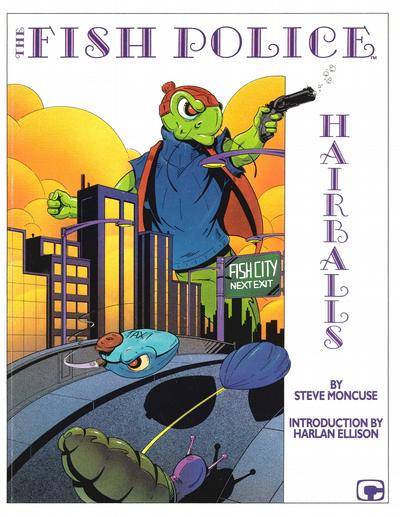
The Fish Police: Hairballs
Comico The Comic Company; $9.95
The mid- to late 1980s was a great time for indie comics as Comico The Comic Company transitioned away from being almost exclusively known for Matt Wagner’s Grendel and Bill Willingham’s Elementals to a diverse line-up of creator-owned and licensed comics and original graphic novels.
In hindsight, the era didn’t last all that long – just a few years – but it brought readers Mage: The Hero Discovered, Jonny Quest, a trio of Robotech series (Robotech: The Macross Saga, Robotech Masters, and Robotech: The New Generation), Justice Machine, Gumby and Space Ghost one-shots, Maze Agency, and the original graphic novels The World of Ginger Fox, Rio, and Night and the Enemy.
It also brought Steve Moncuse’s cult black and white hit, The Fish Police, to a bigger audience.
Fish Police: Hairballs was a European graphic album format (like the Marvel Graphic Novel series) collection of the first four issues of the series, which had originally been published in black and white under Moncuse’s Fishwrap Productions imprint. Cover-dated October 1987, the Comico version presented the first story arc of The Fish Police in color for the first time.
This wasn’t, though, the first Fish Police story at Comico. The Fish Police Special #1 (July 1987), a color prequel to the ongoing series, came out while the main series was still under the Fishwrap banner. That was a teaser of things to come.
For the story that begins in Hairballs, the series is a frequently humorous crime noir pastiche set in an underwater world populated by anthropomorphic sea creatures. Its central character, Inspector Gill, becomes entangled with the alluring Angelfish and her uncle, Calamari, whose mysterious drug called “Hairballs” drives the plot (along with Gill’s flashes of a life when he wasn’t a fish).
There’s plenty of danger, but there’s a significant number of running gags as well.
What begins as a strange encounter in Gill’s apartment expands into a criminal conspiracy involving Castle S.Q.U.I.D. and a supporting cast that includes the Chief, Goldie, Oscar the Octopus, Hook, Line, Sinker, and Blophish.
Moncuse created, wrote, penciled, and inked the series. Tom Vincent added the color for the Comico incarnation.
Some of the story is simply whimsical (For instance, what the evil organization’s acronym S.Q.U.I.D. stands for is never explained), but it’s always balanced with romantic complications, and the traditional intrigue of hard-boiled detective fiction.
After this graphic novel, Comico continued bringing the remaining Fishwrap issues into color. The on-going Comico series started with The Fish Police #5. With The Fish Police #12, it transitioned from colorized reprints of the Fishwrap issues to original material, and ran through #17.
When the Comico series ended, Apple Comics launched The Fish Police #18, and it ran through #26 (cover dated December 1990). Marvel Comics reprinted the first six issues in a 1992-1993 series, and later IDW collected the Hairballs storyline.
Comico’s Fish Police: Hairballs graphic novel remains the best presentation of the material to date. It’s absolutely worth seeking out.
– J.C. Vaughn

Popular Topics
Overstreet Access Quick Links
The Fish Police: Hairballs
Comico The Comic Company; $9.95
The mid- to late 1980s was a great time for indie comics as Comico The Comic Company transitioned away from being almost exclusively known for Matt Wagner’s Grendel and Bill Willingham’s Elementals to a diverse line-up of creator-owned and licensed comics and original graphic novels.
In hindsight, the era didn’t last all that long – just a few years – but it brought readers Mage: The Hero Discovered, Jonny Quest, a trio of Robotech series (Robotech: The Macross Saga, Robotech Masters, and Robotech: The New Generation), Justice Machine, Gumby and Space Ghost one-shots, Maze Agency, and the original graphic novels The World of Ginger Fox, Rio, and Night and the Enemy.
It also brought Steve Moncuse’s cult black and white hit, The Fish Police, to a bigger audience.
Fish Police: Hairballs was a European graphic album format (like the Marvel Graphic Novel series) collection of the first four issues of the series, which had originally been published in black and white under Moncuse’s Fishwrap Productions imprint. Cover-dated October 1987, the Comico version presented the first story arc of The Fish Police in color for the first time.
This wasn’t, though, the first Fish Police story at Comico. The Fish Police Special #1 (July 1987), a color prequel to the ongoing series, came out while the main series was still under the Fishwrap banner. That was a teaser of things to come.
For the story that begins in Hairballs, the series is a frequently humorous crime noir pastiche set in an underwater world populated by anthropomorphic sea creatures. Its central character, Inspector Gill, becomes entangled with the alluring Angelfish and her uncle, Calamari, whose mysterious drug called “Hairballs” drives the plot (along with Gill’s flashes of a life when he wasn’t a fish).
There’s plenty of danger, but there’s a significant number of running gags as well.
What begins as a strange encounter in Gill’s apartment expands into a criminal conspiracy involving Castle S.Q.U.I.D. and a supporting cast that includes the Chief, Goldie, Oscar the Octopus, Hook, Line, Sinker, and Blophish.
Moncuse created, wrote, penciled, and inked the series. Tom Vincent added the color for the Comico incarnation.
Some of the story is simply whimsical (For instance, what the evil organization’s acronym S.Q.U.I.D. stands for is never explained), but it’s always balanced with romantic complications, and the traditional intrigue of hard-boiled detective fiction.
After this graphic novel, Comico continued bringing the remaining Fishwrap issues into color. The on-going Comico series started with The Fish Police #5. With The Fish Police #12, it transitioned from colorized reprints of the Fishwrap issues to original material, and ran through #17.
When the Comico series ended, Apple Comics launched The Fish Police #18, and it ran through #26 (cover dated December 1990). Marvel Comics reprinted the first six issues in a 1992-1993 series, and later IDW collected the Hairballs storyline.
Comico’s Fish Police: Hairballs graphic novel remains the best presentation of the material to date. It’s absolutely worth seeking out.
– J.C. Vaughn
Popular Topics
Overstreet Access Quick Links