



RETRO REVIEW: The Death of Captain Marvel
Marvel Comics; $5.95
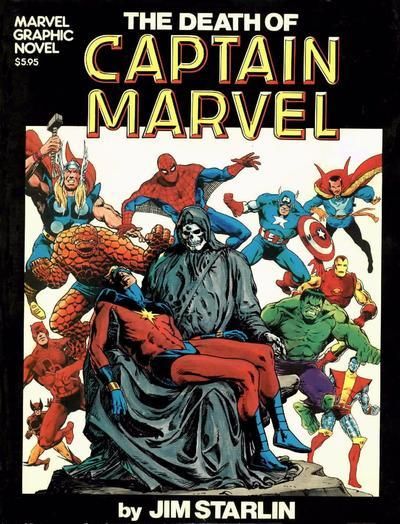
In 1982, when writer-artist Jim Starlin put together a coda to his association with Marvel's first Captain Marvel, it was billed as a special event. It received special treatment as the debut of the company's graphic novel line – larger format, great paper stock, beautiful coloring from Steve Oliff, and a healthy bit of promotion. The adoption of the European graphic album format was billed as – and indeed was – a significant event in the American comic book world.
It was retroactively billed at Marvel Graphic Novel #1, though that was not included in the indicia. That name was, though, included on the upper left-hand side of the front cover above the price, $5.95, which seemed a bit steep before readers got a chance to dive into its pages.
Background
Mar-Vell, a warrior originally from the star-spanning Kree Empire, was created by writer Stan Lee and artist Gene Colan in Marvel Super-Heroes #12 (December 1967). The character eventually turned his back on the Kree and became a defender of Earth and humanity.
His own series began with the May 1968 cover-dated Captain Marvel #1, which sparked a number of changes in creative direction as the series ran. Among the most notable came in Captain Marvel #17 (October 1969), when writer Roy Thomas and Gil Kane revamped him with the now-familiar red-and-blue costume and the addition of former Incredible Hulk supporting player Rick Jones to the cast.
They also introduced the Nega-Bands as a key story concept.
When Mar-Vell is trapped in the Negative Zone, he is able to make mental contact with Jones, who is able to find an abandoned Kree facility on Earth. There Jones finds a pair of Nega-Bands. When he puts them on and clangs them together, he is able to change places with Mar-Vell. Repeating the action also reverses the process and brings Jones back to Earth.
The Nega-Bands also expanded Captain Marvel's powers when he was on Earth. His powers included flight, increased strength, and protection from injury. They would still be a key story element in the Death of Captain Marvel, though they had previously been discarded from the on-going story.
It's worth noting that Captain Marvel trading places with the younger Rick Jones made Marvel's Captain Marvel similar to Fawcett's original Captain Marvel in more than name alone.
Jim Starlin And Captain Marvel
Captain Marvel #25 (March 1973) saw the arrival of Jim Starlin as the series artist with writer Mike Friedrich. Within a few issues, Starlin effectively transformed the story of Captain Marvel into a vast, cosmic saga.
Immediately prior to his stint on Captain Marvel, Starlin had introduced Thanos, Drax the Destroyer, Mentor and other characters and story elements in Iron Man #55. They were rolled into Captain Marvel's world and would form the backbone of what became "The Thanos War."
After his artistic debut on the series, Starlin co-wrote the next three issues, and with Captain Marvel #29 he became the writer of the title as well. Friedrich returned to assist on Captain Marvel #32 and Steve Englehart wrote the dialogue from Starlin's plots on #33 and #34, which concluded Starlin's initial run with the character.
Starlin's final regular issue, Captain Marvel #34 (September 1974). It introduced Nitro, whose battle with Mar-Vell exposed the hero to the poisonous Compound 13 nerve gas. Mar-Vell survived the incident, but years later it would be revealed as the cause of the character's cancer in The Death of Captain Marvel.
Beginning with Strange Tales #178, Starlin began his association with the character Adam Warlock. This would continue in Warlock #9 (the first issue after a two-year cancelation) and run through Warlock #15. Magus, Gamora, Pip and the Soul Gem would all be added to the mythology during this arc.
Starlin would complete the Warlock/Thanos storyline and include Captain Marvel in Avengers Annual #7 (April 1977) and Marvel Two-in-One Annual #2 (May 1977).
Captain Marvel continued under a variety of creators after Starlin's departure, running through Captain Marvel #62 (May 1979). The character also was featured in second series of Marvel Spotlight (July 1979-March 1981), for which he appeared in #1-4 and #8).
The Story
Starlin, long one of the top architects of Marvel's cosmic characters, drew upon not only his own tenure with the character, but the Kree warrior Mar-Vell's whole history. He found the seeds to Captain Marvel's demise – and the inability of the most brilliant minds in the Marvel universe to prevent it – in well-established story elements that were familiar to most of the character's fans, including his own work in Captain Marvel #34.
If one can use the term "humanity" about a Kree warrior, it's Captain Marvel's humanity that gives this story its strength. While he is for the most part philosophical about the end he faces, he is plagued by doubts about the life he led, his impact, and the lives he touched. His friends and a cross section of other heroes are less accepting of his impending fate.
Rereading it again after several years, it remains compelling, insightful, and human stuff.
Mar-Vell's gradual physical decline in the story runs counter to the building frustration of Mister Fantastic, Iron Man, and the Black Panther, among others, as they fail to turn the tide. The reason that it still resonates all these years later is two-fold: cancer is still a scourge to us today, and in comic book terms the character has not been revived, so the story has not been rendered meaningless.
Some installments of the Marvel Graphic Novel I read like glorified annuals, but The Death of Captain Marvel is not one of them. Whether you pick up a first or subsequent printing, it's well worth seeking out.
Marvel Graphic Novel Overview
The Marvel Graphic Novel line was an outlet for some of the company's highest profile projects – the X-Men story God Loves, Man Kills, the launch of The New Mutants, Don McGregor and P. Craig Russell's conclusion of Killraven, and Frank Miller and Bill Sienkiewicz's stunning Daredevil: Love and War, for starters – but it was also an outlet for creator-owned offerings from the top writers and artists working in the field at the time.
In short order, the line-up included Starlin's Dreadstar (following his Metamorphosis Odyssey, which was serialized in Epic Illustrated), Walter Simonson's Star Slammers, Dave Cockrum's Futurians, Rick Veitch's Hearburst, Steve Gerber and Val Mayerick's Void Indigo, Elaine Lee and Michael Wm. Kaluta's Starstruck, and J.M. DeMatteis' Greenberg the Vampire (illustrated by Mark Badger).
Trivia Worth Noting
This wasn't Marvel's actual first graphic novel. That was 1978's The Silver Surfer by Stan Lee and Jack Kirby, published by Simon & Schuster as part of their Fireside Books line. So, Marvel didn't even publish the first Marvel graphic novel.
Additionally, the Marvel Graphic Novel line only carried continuous number for #2 (Elric) through #20 (Greenberg the Vampire). Following a consensus among the Overstreet Advisors, The Overstreet Comic Book Price Guide attached numbers to #21 (Marada The She-Wolf) through #38 (Silver Surfer: Judgment Day) as part of the series. Subsequent Marvel Graphic Novel entries were their own listings.
The original Ms. Marvel, Carol Danvers first appears in Marvel Super-Heroes #13 (March 1968) as the security chief at the military installation at which Mar-Vell operates under the identity of the deceased Dr. Walter Lawson. In Captain Marvel #18 (November 1969), she's caught in an explosion of the Kree Psyche-Magnitron, which is later explained to be the origin of her powers as seen in Ms. Marvel #1 (January 1977).
– J.C. Vaughn

Popular Topics
Overstreet Access Quick Links
RETRO REVIEW: The Death of Captain Marvel
Marvel Comics; $5.95
In 1982, when writer-artist Jim Starlin put together a coda to his association with Marvel's first Captain Marvel, it was billed as a special event. It received special treatment as the debut of the company's graphic novel line – larger format, great paper stock, beautiful coloring from Steve Oliff, and a healthy bit of promotion. The adoption of the European graphic album format was billed as – and indeed was – a significant event in the American comic book world.
It was retroactively billed at Marvel Graphic Novel #1, though that was not included in the indicia. That name was, though, included on the upper left-hand side of the front cover above the price, $5.95, which seemed a bit steep before readers got a chance to dive into its pages.
Background
Mar-Vell, a warrior originally from the star-spanning Kree Empire, was created by writer Stan Lee and artist Gene Colan in Marvel Super-Heroes #12 (December 1967). The character eventually turned his back on the Kree and became a defender of Earth and humanity.
His own series began with the May 1968 cover-dated Captain Marvel #1, which sparked a number of changes in creative direction as the series ran. Among the most notable came in Captain Marvel #17 (October 1969), when writer Roy Thomas and Gil Kane revamped him with the now-familiar red-and-blue costume and the addition of former Incredible Hulk supporting player Rick Jones to the cast.
They also introduced the Nega-Bands as a key story concept.
When Mar-Vell is trapped in the Negative Zone, he is able to make mental contact with Jones, who is able to find an abandoned Kree facility on Earth. There Jones finds a pair of Nega-Bands. When he puts them on and clangs them together, he is able to change places with Mar-Vell. Repeating the action also reverses the process and brings Jones back to Earth.
The Nega-Bands also expanded Captain Marvel's powers when he was on Earth. His powers included flight, increased strength, and protection from injury. They would still be a key story element in the Death of Captain Marvel, though they had previously been discarded from the on-going story.
It's worth noting that Captain Marvel trading places with the younger Rick Jones made Marvel's Captain Marvel similar to Fawcett's original Captain Marvel in more than name alone.
Jim Starlin And Captain Marvel
Captain Marvel #25 (March 1973) saw the arrival of Jim Starlin as the series artist with writer Mike Friedrich. Within a few issues, Starlin effectively transformed the story of Captain Marvel into a vast, cosmic saga.
Immediately prior to his stint on Captain Marvel, Starlin had introduced Thanos, Drax the Destroyer, Mentor and other characters and story elements in Iron Man #55. They were rolled into Captain Marvel's world and would form the backbone of what became "The Thanos War."
After his artistic debut on the series, Starlin co-wrote the next three issues, and with Captain Marvel #29 he became the writer of the title as well. Friedrich returned to assist on Captain Marvel #32 and Steve Englehart wrote the dialogue from Starlin's plots on #33 and #34, which concluded Starlin's initial run with the character.
Starlin's final regular issue, Captain Marvel #34 (September 1974). It introduced Nitro, whose battle with Mar-Vell exposed the hero to the poisonous Compound 13 nerve gas. Mar-Vell survived the incident, but years later it would be revealed as the cause of the character's cancer in The Death of Captain Marvel.
Beginning with Strange Tales #178, Starlin began his association with the character Adam Warlock. This would continue in Warlock #9 (the first issue after a two-year cancelation) and run through Warlock #15. Magus, Gamora, Pip and the Soul Gem would all be added to the mythology during this arc.
Starlin would complete the Warlock/Thanos storyline and include Captain Marvel in Avengers Annual #7 (April 1977) and Marvel Two-in-One Annual #2 (May 1977).
Captain Marvel continued under a variety of creators after Starlin's departure, running through Captain Marvel #62 (May 1979). The character also was featured in second series of Marvel Spotlight (July 1979-March 1981), for which he appeared in #1-4 and #8).
The Story
Starlin, long one of the top architects of Marvel's cosmic characters, drew upon not only his own tenure with the character, but the Kree warrior Mar-Vell's whole history. He found the seeds to Captain Marvel's demise – and the inability of the most brilliant minds in the Marvel universe to prevent it – in well-established story elements that were familiar to most of the character's fans, including his own work in Captain Marvel #34.
If one can use the term "humanity" about a Kree warrior, it's Captain Marvel's humanity that gives this story its strength. While he is for the most part philosophical about the end he faces, he is plagued by doubts about the life he led, his impact, and the lives he touched. His friends and a cross section of other heroes are less accepting of his impending fate.
Rereading it again after several years, it remains compelling, insightful, and human stuff.
Mar-Vell's gradual physical decline in the story runs counter to the building frustration of Mister Fantastic, Iron Man, and the Black Panther, among others, as they fail to turn the tide. The reason that it still resonates all these years later is two-fold: cancer is still a scourge to us today, and in comic book terms the character has not been revived, so the story has not been rendered meaningless.
Some installments of the Marvel Graphic Novel I read like glorified annuals, but The Death of Captain Marvel is not one of them. Whether you pick up a first or subsequent printing, it's well worth seeking out.
Marvel Graphic Novel Overview
The Marvel Graphic Novel line was an outlet for some of the company's highest profile projects – the X-Men story God Loves, Man Kills, the launch of The New Mutants, Don McGregor and P. Craig Russell's conclusion of Killraven, and Frank Miller and Bill Sienkiewicz's stunning Daredevil: Love and War, for starters – but it was also an outlet for creator-owned offerings from the top writers and artists working in the field at the time.
In short order, the line-up included Starlin's Dreadstar (following his Metamorphosis Odyssey, which was serialized in Epic Illustrated), Walter Simonson's Star Slammers, Dave Cockrum's Futurians, Rick Veitch's Hearburst, Steve Gerber and Val Mayerick's Void Indigo, Elaine Lee and Michael Wm. Kaluta's Starstruck, and J.M. DeMatteis' Greenberg the Vampire (illustrated by Mark Badger).
Trivia Worth Noting
This wasn't Marvel's actual first graphic novel. That was 1978's The Silver Surfer by Stan Lee and Jack Kirby, published by Simon & Schuster as part of their Fireside Books line. So, Marvel didn't even publish the first Marvel graphic novel.
Additionally, the Marvel Graphic Novel line only carried continuous number for #2 (Elric) through #20 (Greenberg the Vampire). Following a consensus among the Overstreet Advisors, The Overstreet Comic Book Price Guide attached numbers to #21 (Marada The She-Wolf) through #38 (Silver Surfer: Judgment Day) as part of the series. Subsequent Marvel Graphic Novel entries were their own listings.
The original Ms. Marvel, Carol Danvers first appears in Marvel Super-Heroes #13 (March 1968) as the security chief at the military installation at which Mar-Vell operates under the identity of the deceased Dr. Walter Lawson. In Captain Marvel #18 (November 1969), she's caught in an explosion of the Kree Psyche-Magnitron, which is later explained to be the origin of her powers as seen in Ms. Marvel #1 (January 1977).
– J.C. Vaughn
Popular Topics
Overstreet Access Quick Links