



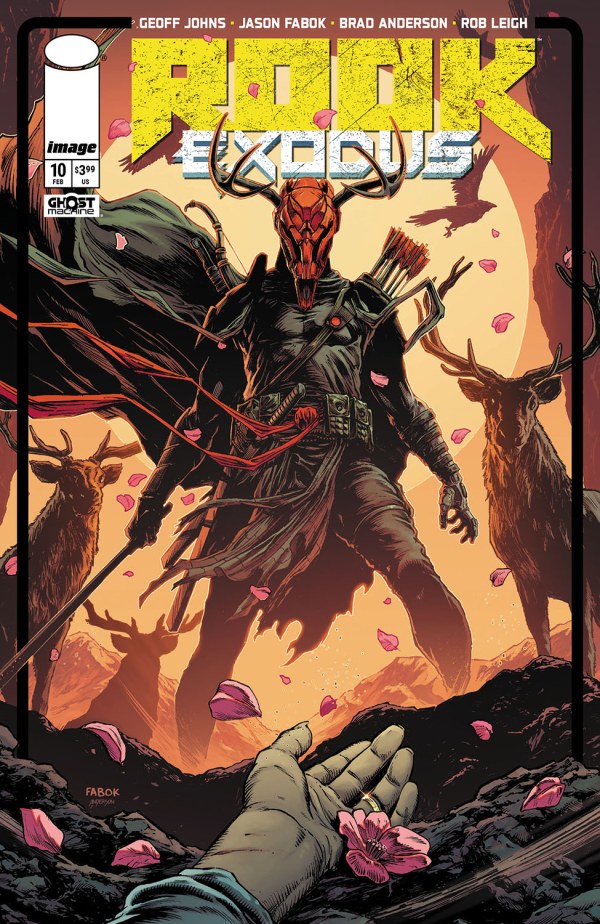
Rook: Exodus #10
Image Comics; $3.99
Actual science fiction is actually occurring.
Writer Geoff Johns, artist Jason Fabok, and colorist Brad Anderson continue to deliver one of the best serialized comic books on the market today, and one of the reasons Rook: Exodus is so good is that it is fundamentally science fiction rather than a superhero comic in disguise.
Don't get me wrong, I love superhero comics. But just like a lot of horror comics, many ostensibly science fiction comics turn out to be superhero stories with science fiction window dressing. For fans of those genres, it feels like bait and switch when that happens, and that diminishes whatever excitement was built up for the property.
That is not the case here.
At my local comic shop, arguments stop and agreements begin when it is mentioned. No one who is reading this series isn't hooked on it.
Johns, Fabok, and Anderson (and for that matter, letterer Rob Leigh) have built an incredible world and they continue to explore it in a way that each issue builds on what's come before and sets up what's coming next.
The series takes place centuries in the future on Exodus, a terraformed planet created by the Better-World Corporation. Exodus was engineered so that specially equipped humans called Wardens could control every aspect of the ecosystem through technologically linked animal "masks" or helmets.
The protagonist, Rook, is a former Illinois farmer who emigrated from a dying Earth and became the Warden of birds. When Exodus' planetary World Engine begins failing, society collapses. The wealthy flee, the corporation abandons the world, and rival Wardens battle over the remaining resources while the planet slowly dies.
Among the powerful running themes in the series are environmental collapse, terraforming technology, competing philosophies about stewardship versus control, human adaptation to engineered ecosystems, and the political struggles among survivors of a failed colony world.
The Wardens may look like costumed heroes, but they function more like technologically enhanced administrators, soldiers, and ecological engineers. In fact, one could argue that it's almost a science fiction story disguised as superhero tale, instead of the opposite.
Rook: Exodus #1–6 featured the introduction of the world and the set-up for the series. Its main focus was Rook's struggle with Ursaw, the Bear Warden. We met other wardens such as Dire Wolf as well.
The second story arc began in #7, which kicked off a search for the warden Bloodhound,
Dire Wolf's father. In theory, Bloodhound might know how to repair the failing World Engine. However, he's been altered by the animal instincts to which he's been connected, or so it seems.
Issues of desperation, family, and moral choices vs. plain survival permeate this arc, and this issue is no exception.
The only complaint I have is the long wait between some of the installments. That usually goes away once I'm reading an issue, but I certainly wish they arrived more frequently. To be fair, though, I'd probably feel that way if it was monthly, too.
If you've missed the series thus far, there's a good trade paperback (or an even better hardcover) of the first arc, but you might want to just go track down the issues. You'll be glad you did.
– J.C. Vaughn

Popular Topics
Overstreet Access Quick Links
Rook: Exodus #10
Image Comics; $3.99
Actual science fiction is actually occurring.
Writer Geoff Johns, artist Jason Fabok, and colorist Brad Anderson continue to deliver one of the best serialized comic books on the market today, and one of the reasons Rook: Exodus is so good is that it is fundamentally science fiction rather than a superhero comic in disguise.
Don't get me wrong, I love superhero comics. But just like a lot of horror comics, many ostensibly science fiction comics turn out to be superhero stories with science fiction window dressing. For fans of those genres, it feels like bait and switch when that happens, and that diminishes whatever excitement was built up for the property.
That is not the case here.
At my local comic shop, arguments stop and agreements begin when it is mentioned. No one who is reading this series isn't hooked on it.
Johns, Fabok, and Anderson (and for that matter, letterer Rob Leigh) have built an incredible world and they continue to explore it in a way that each issue builds on what's come before and sets up what's coming next.
The series takes place centuries in the future on Exodus, a terraformed planet created by the Better-World Corporation. Exodus was engineered so that specially equipped humans called Wardens could control every aspect of the ecosystem through technologically linked animal "masks" or helmets.
The protagonist, Rook, is a former Illinois farmer who emigrated from a dying Earth and became the Warden of birds. When Exodus' planetary World Engine begins failing, society collapses. The wealthy flee, the corporation abandons the world, and rival Wardens battle over the remaining resources while the planet slowly dies.
Among the powerful running themes in the series are environmental collapse, terraforming technology, competing philosophies about stewardship versus control, human adaptation to engineered ecosystems, and the political struggles among survivors of a failed colony world.
The Wardens may look like costumed heroes, but they function more like technologically enhanced administrators, soldiers, and ecological engineers. In fact, one could argue that it's almost a science fiction story disguised as superhero tale, instead of the opposite.
Rook: Exodus #1–6 featured the introduction of the world and the set-up for the series. Its main focus was Rook's struggle with Ursaw, the Bear Warden. We met other wardens such as Dire Wolf as well.
The second story arc began in #7, which kicked off a search for the warden Bloodhound,
Dire Wolf's father. In theory, Bloodhound might know how to repair the failing World Engine. However, he's been altered by the animal instincts to which he's been connected, or so it seems.
Issues of desperation, family, and moral choices vs. plain survival permeate this arc, and this issue is no exception.
The only complaint I have is the long wait between some of the installments. That usually goes away once I'm reading an issue, but I certainly wish they arrived more frequently. To be fair, though, I'd probably feel that way if it was monthly, too.
If you've missed the series thus far, there's a good trade paperback (or an even better hardcover) of the first arc, but you might want to just go track down the issues. You'll be glad you did.
– J.C. Vaughn
Popular Topics
Overstreet Access Quick Links