



RETRO REVIEW: The Silver Surfer: Parable
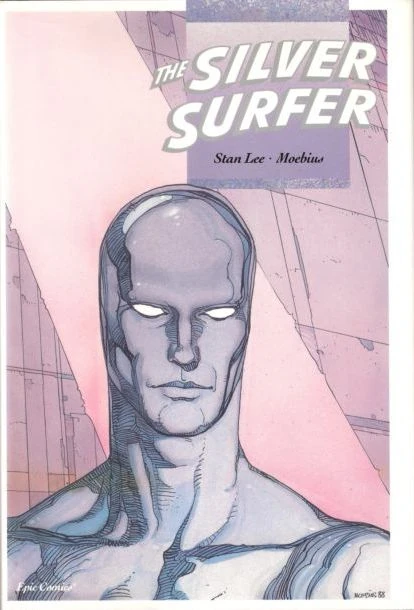
Epic Comics; $19.95
I don’t think that anyone ever captured the power, majesty, nobility, and the epic nature of the Silver Surfer as well as Stan Lee and John Buscema did in the character’s original 1968 series, but I do have a real soft spot for Silver Surfer: Parable.
Originally published as a two-issue mini-series under Marvel’s Epic Comics imprint, Silver Surfer: Parable teamed Lee with French artist Moebius (Jean Giraud) for an out-of-continuity retelling of the Surfer’s rebellion against Galactus on behalf of the mostly undeserving people of Earth.
A number of works by Moebius were collected in a beautiful (and now highly sought-after) Epic Comics graphic novel series, but he had never worked on what he called “a real, American comic book.” Following a meeting at the 1987 San Diego Comic-Con, Marvel teamed Moebius and Lee for the project.
Lee provided a detailed six-page plot – it was the first time working the Marvel style for the artist – and Moebius went to work. Lee then dialogued the pages Moebius produced. Mark Chiarello and John Wellington provided the colors. Moebius himself lettered the book.
The results, like the Lee-Kirby 1978 original graphic novel The Silver Surfer (published Simon & Schuster’s Fireside Books imprint), is a tale that gets to the core of the Surfer’s identity without either the benefit or the distraction of other Marvel characters.
The Surfer finds Earth, a world that can temporarily satiate the never-ending hunger of the world-devouring Galactus, but quickly regrets it as he sees the potential of mankind. Among the turmoil caused by the arrival of Galactus, a televangelist, Rev. Colton Candell, casts his previously espoused faith aside and anoints himself as the prophet of Galactus. Even in 1988, without social media, there are plenty of opinions of what to do and what’s going to happen.
True to the character, the Surfer is a beacon of hope, one man standing for what is right, despite the actions of those around him and regardless of the personal cost. Again, nobility is the right word to describe the character’s singular trait.
The 1988 hardcover collection, which can be difficult to find, is worth the hunt. With Lee’s introduction and detailed notes from Moebius on each stage of the process, the book (complete with dust jacket) is a treasure.
– J.C. Vaughn

Popular Topics
Overstreet Access Quick Links
RETRO REVIEW: The Silver Surfer: Parable
Epic Comics; $19.95
I don’t think that anyone ever captured the power, majesty, nobility, and the epic nature of the Silver Surfer as well as Stan Lee and John Buscema did in the character’s original 1968 series, but I do have a real soft spot for Silver Surfer: Parable.
Originally published as a two-issue mini-series under Marvel’s Epic Comics imprint, Silver Surfer: Parable teamed Lee with French artist Moebius (Jean Giraud) for an out-of-continuity retelling of the Surfer’s rebellion against Galactus on behalf of the mostly undeserving people of Earth.
A number of works by Moebius were collected in a beautiful (and now highly sought-after) Epic Comics graphic novel series, but he had never worked on what he called “a real, American comic book.” Following a meeting at the 1987 San Diego Comic-Con, Marvel teamed Moebius and Lee for the project.
Lee provided a detailed six-page plot – it was the first time working the Marvel style for the artist – and Moebius went to work. Lee then dialogued the pages Moebius produced. Mark Chiarello and John Wellington provided the colors. Moebius himself lettered the book.
The results, like the Lee-Kirby 1978 original graphic novel The Silver Surfer (published Simon & Schuster’s Fireside Books imprint), is a tale that gets to the core of the Surfer’s identity without either the benefit or the distraction of other Marvel characters.
The Surfer finds Earth, a world that can temporarily satiate the never-ending hunger of the world-devouring Galactus, but quickly regrets it as he sees the potential of mankind. Among the turmoil caused by the arrival of Galactus, a televangelist, Rev. Colton Candell, casts his previously espoused faith aside and anoints himself as the prophet of Galactus. Even in 1988, without social media, there are plenty of opinions of what to do and what’s going to happen.
True to the character, the Surfer is a beacon of hope, one man standing for what is right, despite the actions of those around him and regardless of the personal cost. Again, nobility is the right word to describe the character’s singular trait.
The 1988 hardcover collection, which can be difficult to find, is worth the hunt. With Lee’s introduction and detailed notes from Moebius on each stage of the process, the book (complete with dust jacket) is a treasure.
– J.C. Vaughn
Popular Topics
Overstreet Access Quick Links