



RETRO REVIEW: Hell on Earth
DC Comics; $5.95
"Would you go to hell for $100,000?" asks Professor Keith.
"Brother, just show me the money and tell me when the next train leaves," replies struggling writer Guy Roberts.
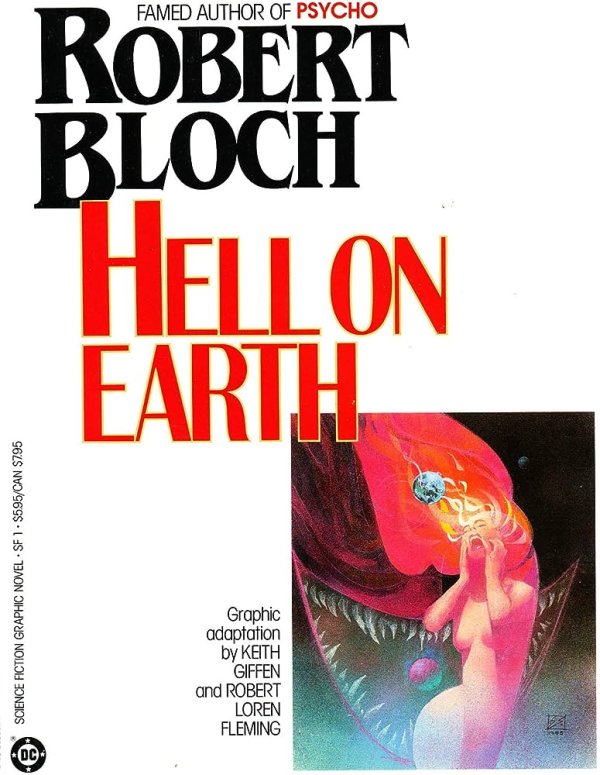
That's the opening salvo of Hell on Earth, alternately known as DC Science Fiction Graphic Novel #1. Cover dated January 1985, it's based on Psycho author Robert Bloch's short story of the same name, which originally appeared in the May 1942 issue of the pulp magazine Weird Tales. It was adapted by writer-artist Keith Giffen (Ambush Bug) and writer Robert Loren Fleming (Thriller).
Background
By the mid-1980s, the European graphic album format was making its presence felt in the US with the Marvel Graphic Novel series and others. The DC Science Fiction Graphic Novel line was the brainchild and last official DC project of veteran editor Julius "Julie" Schwartz (1915-2004), one of the most pivotal editors in the medium's history and architect of DC's Silver Age revitalization of the superhero genre.
Schwartz's connections to science fiction dated back to at least 1932, when he and Mort Weisinger, later a fellow DC editor, helped publish The Time Traveller, one of the earliest science fiction fanzines. They also formed a literary agency whose clients included Bloch, Alfred Bester, and Ray Bradbury, among others.
So, it made sense that Schwartz might look back to his earliest days for a significant use of the graphic album format and give them a more literary bent (though, to be clear, I can't find any direct quote from Schwartz saying that's what went on).
The line would eventually include seven original graphic novels.
Bloch's Hell on Earth was followed by #2 Robert Silverberg's Nightwings, #3 Ray Bradbdury's Frost and Fire, #4 Frederik Pohl's Merchants of Venus, #5 Harlan Ellison's Demon With a Glass Hand, #6 Larry Niven's The Magic Goes Away, and #7 George R.R. Martin's Sandkings.
The Work
The story is told almost (but not quite) exclusively in 16-panel pages. Giffen's use of small panels, some with substantial amounts of text, was a very different approach than he had been known for up to that point. It represented a bold, deliberate choice in how to convey Bloch's story.
Flemmings adaptation keeps the central narrator and the tone of Bloch's prose. Together with Giffen's art, these take the reader deeper into the story.
It's worth noting that that "Hell on Earth" was not one of Bloch's more famous stories. Clearly, "Yours Truly, Jack the Ripper" and others had far more commercial success. It had not even been included in his short story collections at the point the graphic novel was published, so that makes the choice of this one to launch the line even more interesting.
Conclusion
The American version of the European graphic album format was in its heyday in the 1980s, and DC's attempt to give it a more literary feel was a significant experiment. Now, as collectors begin to realize the relative rarity of high grade copies of many of the graphic novels, interest in them is being revived.
Such modern projects as DC's Superman: Year One (2019), The Batman: First Knight (2024), and publisher DSTLRY's line definitely contribute to the awareness and resurgence of the format.
– J.C. Vaughn

Popular Topics
Overstreet Access Quick Links
RETRO REVIEW: Hell on Earth
DC Comics; $5.95
"Would you go to hell for $100,000?" asks Professor Keith.
"Brother, just show me the money and tell me when the next train leaves," replies struggling writer Guy Roberts.
That's the opening salvo of Hell on Earth, alternately known as DC Science Fiction Graphic Novel #1. Cover dated January 1985, it's based on Psycho author Robert Bloch's short story of the same name, which originally appeared in the May 1942 issue of the pulp magazine Weird Tales. It was adapted by writer-artist Keith Giffen (Ambush Bug) and writer Robert Loren Fleming (Thriller).
Background
By the mid-1980s, the European graphic album format was making its presence felt in the US with the Marvel Graphic Novel series and others. The DC Science Fiction Graphic Novel line was the brainchild and last official DC project of veteran editor Julius "Julie" Schwartz (1915-2004), one of the most pivotal editors in the medium's history and architect of DC's Silver Age revitalization of the superhero genre.
Schwartz's connections to science fiction dated back to at least 1932, when he and Mort Weisinger, later a fellow DC editor, helped publish The Time Traveller, one of the earliest science fiction fanzines. They also formed a literary agency whose clients included Bloch, Alfred Bester, and Ray Bradbury, among others.
So, it made sense that Schwartz might look back to his earliest days for a significant use of the graphic album format and give them a more literary bent (though, to be clear, I can't find any direct quote from Schwartz saying that's what went on).
The line would eventually include seven original graphic novels.
Bloch's Hell on Earth was followed by #2 Robert Silverberg's Nightwings, #3 Ray Bradbdury's Frost and Fire, #4 Frederik Pohl's Merchants of Venus, #5 Harlan Ellison's Demon With a Glass Hand, #6 Larry Niven's The Magic Goes Away, and #7 George R.R. Martin's Sandkings.
The Work
The story is told almost (but not quite) exclusively in 16-panel pages. Giffen's use of small panels, some with substantial amounts of text, was a very different approach than he had been known for up to that point. It represented a bold, deliberate choice in how to convey Bloch's story.
Flemmings adaptation keeps the central narrator and the tone of Bloch's prose. Together with Giffen's art, these take the reader deeper into the story.
It's worth noting that that "Hell on Earth" was not one of Bloch's more famous stories. Clearly, "Yours Truly, Jack the Ripper" and others had far more commercial success. It had not even been included in his short story collections at the point the graphic novel was published, so that makes the choice of this one to launch the line even more interesting.
Conclusion
The American version of the European graphic album format was in its heyday in the 1980s, and DC's attempt to give it a more literary feel was a significant experiment. Now, as collectors begin to realize the relative rarity of high grade copies of many of the graphic novels, interest in them is being revived.
Such modern projects as DC's Superman: Year One (2019), The Batman: First Knight (2024), and publisher DSTLRY's line definitely contribute to the awareness and resurgence of the format.
– J.C. Vaughn
Popular Topics
Overstreet Access Quick Links