



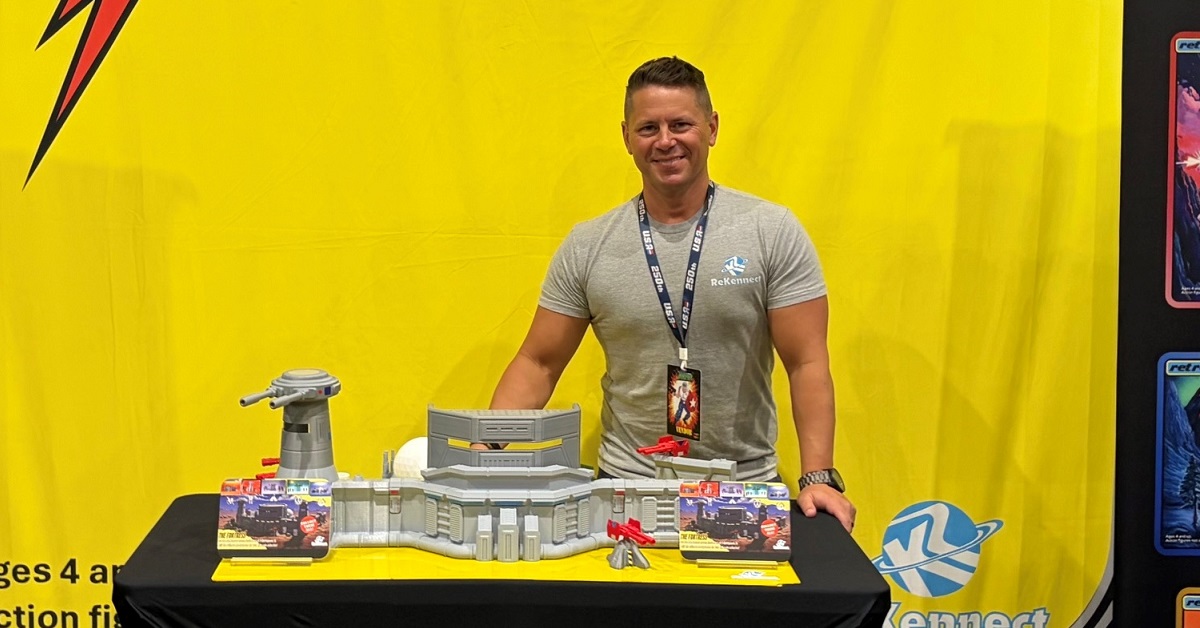
ReKennect Founder Richard Reinhardt on Reviving Action Figure Playsets
Toy collectors remember their childhoods fondly, reminiscing about the days when their to do list was playing in the imaginative worlds of their favorite toys. Collectors display their toys and introduce them to new generations, which inspired Richard Reinhardt to create ReKennect. The company founder and CEO took that nostalgia into modern territory by creating new playsets that are compatible with various vintage toy lines and some more recent releases. Reinhardt talked to Scoop about his inspiration for the company, developing the playset line, what it includes, and plans for the future.
Scoop: Let’s start by telling readers what is ReKennect.
Richard Reinhardt (RR): Okay, great first question. ReKennect is a startup Maryland-based toy company. We began this journey almost 12 or 13 years ago. What we are doing is bringing back modular 1/18 scale playsets to the modern day collector, the Gen. X collectors, the Gen. X parents. Also just reviving the old tactile adventure playsets and castles that we grew up with and giving it to the next generation of kids.
Our modular playsets have an aesthetic that looks very similar to what you may have remembered back in the late ‘70s, early ‘80s, whether it was like a Hasbro G.I. Joe playset or something similar to what you would see from the Kenner Star Wars line.
But it’s modernized. It’s not taking carbon copies of those designs. There’s some DNA within our designs that we’ve made, but we’ve made them our own. They’re all independently original designs. And what we find unique about ours is that we don’t use clip-on snaps or hooks or hinges. Our modular playsets are connected, what we call MagKennect. There’s magnets within every playset, so the kid or the collector can build or configure our playsets in any way they want. We always say, “The only limitation is your imagination.”
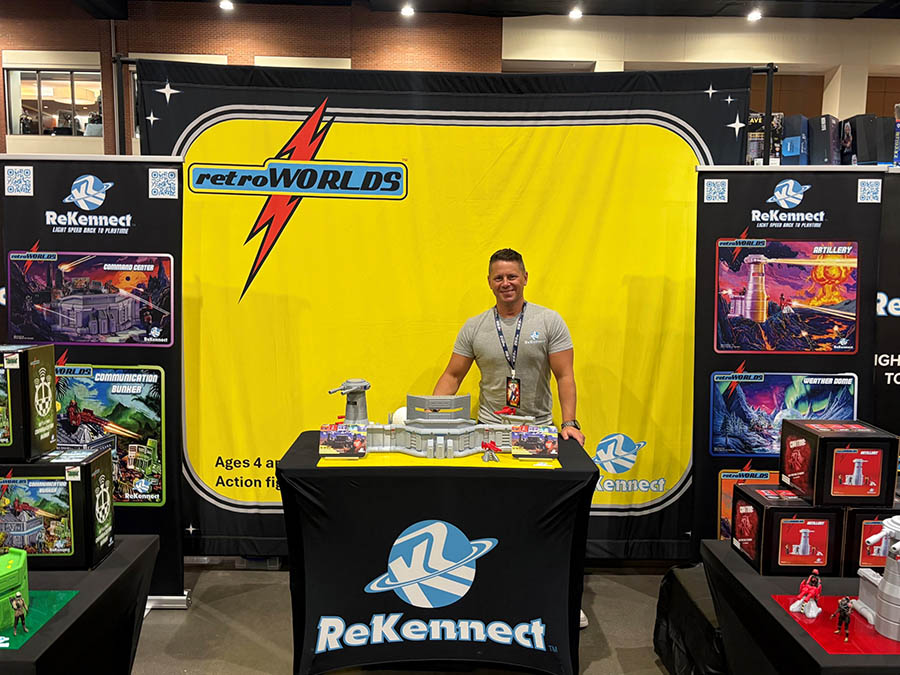
It’s a world building playset where the individual playset can stand on its own for your adventure or your mission or your display. But if you want to keep on building or creating more, you have the options to make the modular playsets into whatever configuration you want. You can turn it into a bunker, you can turn it into a super fortress. So, there’s a lot of versatility with our toys.
We’re proud to say that not only are we based in Maryland as a domestic toy company startup, but all of our toys are actually produced and manufactured right in Georgia. We take a lot of pride to say that we are a born in the USA – as [Bruce] Springsteen used to say – toy company.
Scoop: What are some of the fun playsets and accessories collectors can purchase?
RR: That’s another great question. We took a lot of time really thinking about the details of each set. We looked at it, we took a lot of time with focus groups, hearing from parents to collectors to kids, what they want, what they remember, some of the things they wish they had, things that they had but could have been better improved in terms of design. We’ve created five separate sets in our first chapter, as we call it.
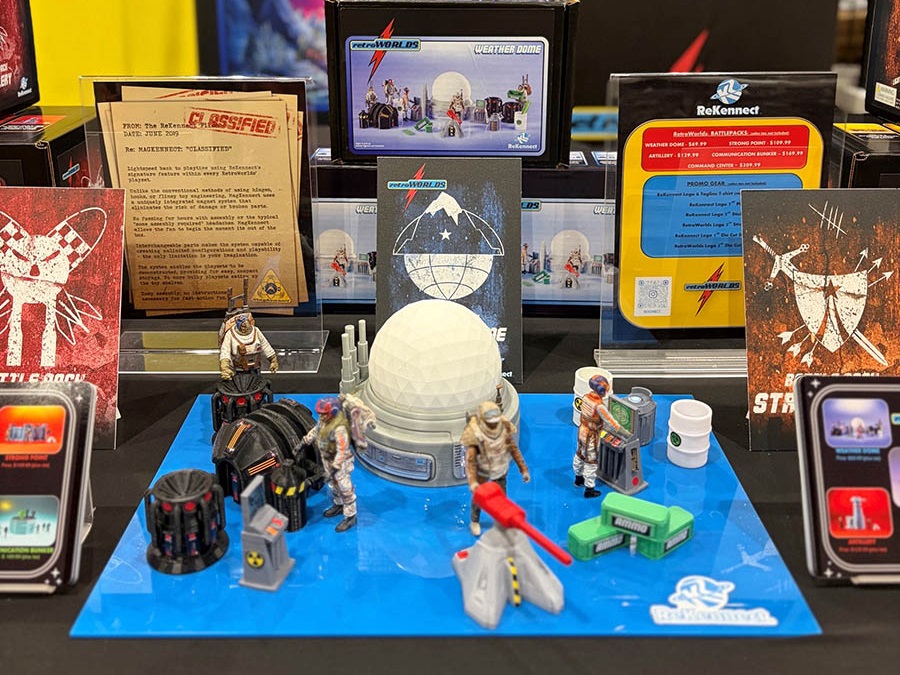
The first chapter has a small range of, like, an introductory set called the Weather Dome. It’s a little playset that comes with a lot of accessories. The set has a modular dome that actually opens up where it reveals a cache of tons of equipment for your field missions. You’ve got ammo crates that actually open up to store your little action figure weaponry. You’ve got barrels, you’ve got computers, you’ve got weather sensors. And again, the MagKennect system is in every integrated playset. It comes with an artillery cannon and a tripod, and that is connected by magnets. You can dismantle it or make it battle damaged. You can make it move around. The dome, like I said, opens up so you can fill in whatever you want. Whether it’s your action figure accessories or action figures that you have in your toy box, they can load up into one and it can be on its way outside in the sandbox or heading to grandmom’s house for the weekend. You’ve got your own sort of portable playset.
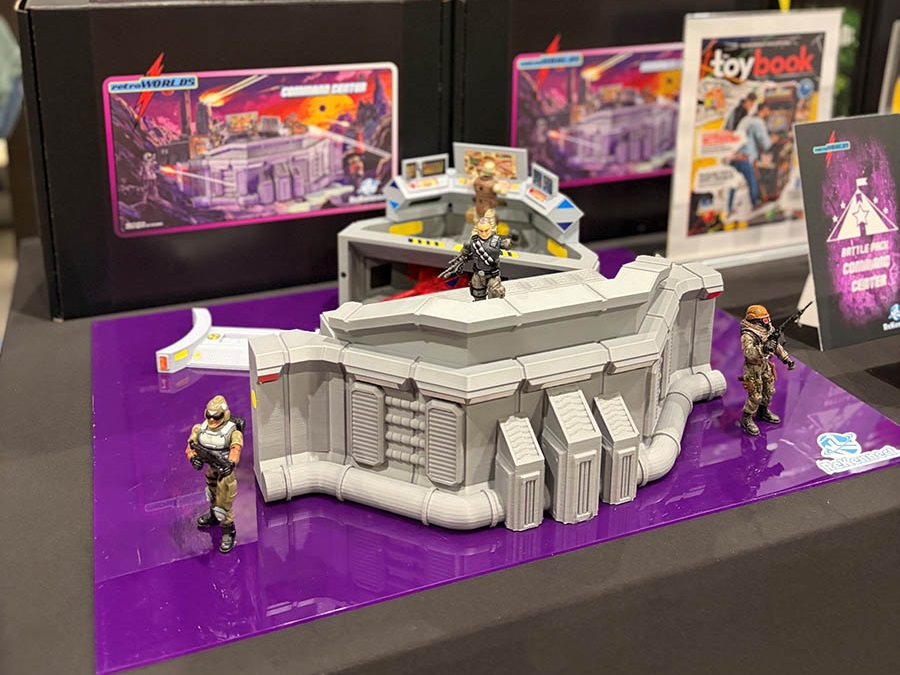
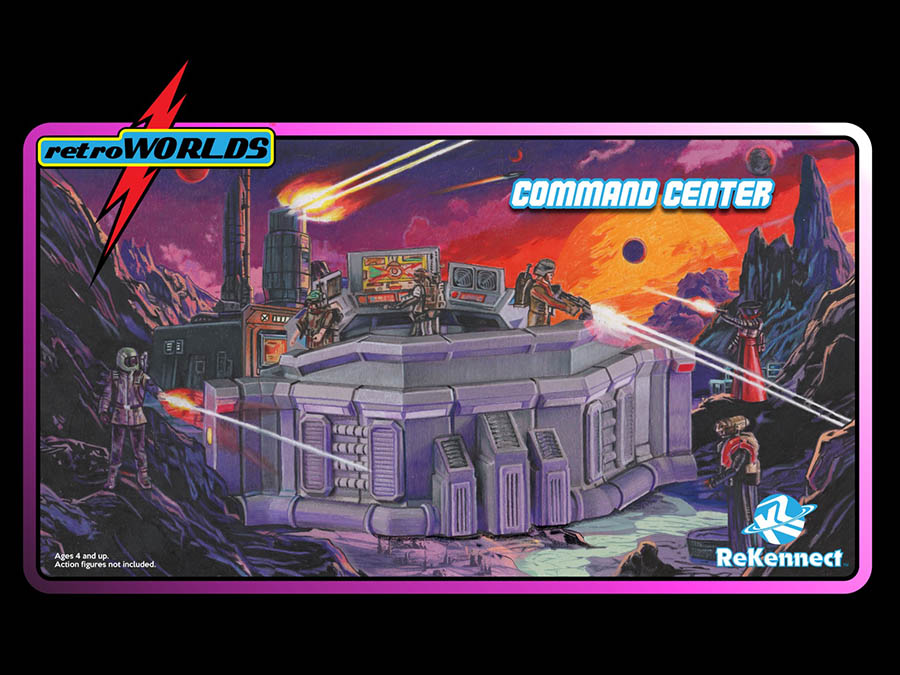
We have a smaller set where you have tons of activities and accessories, and then you scale upward to our most recent Command Center that we launched last year, which is sort of the flagship. The Command Center is the central piece that links all of the other modular playsets together to make this super fortress. And while it’s bigger in scale, you don’t have a lot of accessories, but it comes with a lot of playability. So, the interconnectivity of all the other playsets connect to the central hub of the Command Center, it comes with the MagKennect detachable command computer console. It opens up to reveal two different pieces of the playset where you can put in storage. You can add your armament in the storage rooms, or you can use it as a dungeon if you like. It also comes with an attachment we call the energy walkway, which then attaches to the Weather Dome. So again, everything’s sort of interconnected, but it also depends on the range of the size and the pricing of our sets. The smaller the set, we pack in a lot of accessories and a lot of fun gadgetry. The larger the set, the bigger the playset, but fewer of the accessories.
Scoop: What toy lines would you say are most compatible with your Retro Worlds?
RR: We started out thinking when we were designing our Retro World collection, the 1/18 scale, and we continue to keep that as sort of the toy line size. So, anything that is in your shelf, from your old ‘80s or late ‘70s Micronauts to your Star Wars, to your G.I. Joes, to modern day 1/18 scale independent toys that you see at the cons and whatnot, like a Skeletron or even a Delta 17.
But one of the things that we discovered early on when we launched back four years ago, the Mini Mates community, they’ve really embraced us. Now they’re kind of a size in between Legos and 3-3/4-inch scale. And to our delight, we’ve seen this community really embrace us, they feel that our scale of toys and some of the accessories that come with our toys actually meets the scale for those action figures. They love the sets. They feel like it’s a world building environment for that toy line. If I were to place a size, I would say now Mini Mates would be in that scale, but generally speaking, the 3-3/4-inch, 1/18 scale is where we sit.
Scoop: That’s pretty cool. I didn’t think about the Mini Mates, but that makes sense.
RR: Yeah, we were so delighted. We didn’t even think about it, but one of our first customers purchased the Weather Dome, and they were a big Mini Mates collector, and they just fell in love with the size of the scalability for their environments. And before we knew it, we saw the first couple of our customers were Mini Mates collectors. So, we’re like, wow, this is really great. A nice little hidden surprise we didn’t even see happen. As Bob Ross would say, a happy accident.
Scoop: All kids play with toys, but very few work in the hobby as adults. What has driven your passion for toys from childhood to collecting and working in the industry today?
RR: Great question again. I feel, you know, there’s a connection to my childhood that I think is inherent with all of us in this industry and in this culture, pop culture. I feel like there’s a sense of when you’re holding something tactile, you almost immerse yourself in your own imagination, your own creativity, your own story. You create your own mythology of those toys. And you can’t get that off of a video game or a tablet these days. And I think for me, the inspiration really transcended out of my childhood with my imagination and creativity. I went to art school, and I started to become an actual professional artist and illustrator. I feel like that helped me continue into what I’m doing now.
But I think really part of the inspiration that generated ReKennect came from my nephew. Being the cool godfather that I was, I saw my nephew, at the time about 13 years ago, playing with all my old stuff. And I would go to the toy aisles to find him the new latest castle or command center, and we didn’t really see that. The big toy companies weren’t making that stuff. And so to me, I thought, I want to bring that back to this next generation. I’ve seen parents, with young kids being on the floor, creating little castles and whatnot, and I was doing the same, but I felt that there was a need for us to bring that part of the toy aisle back, that toy line back.
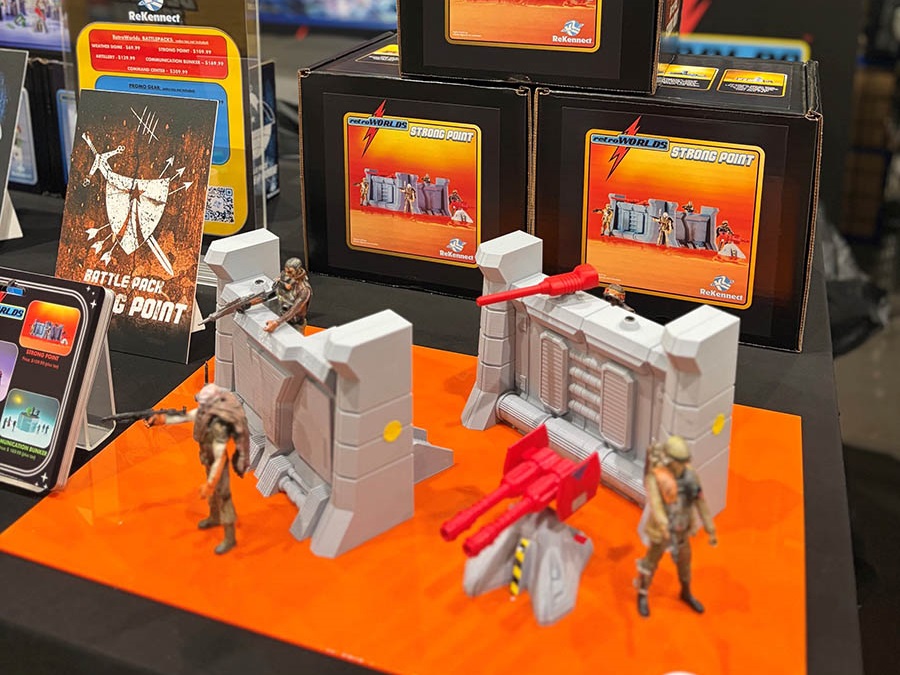
I feel that you can have a wide range of action figures, some really great designs and really great ingenuity now, but the vehicles and the playsets just seem to be lost on the shelves these days. And to me, I feel like you can’t really build a world of playability and creativity and adventure with just an action figure. I thought, well, let’s take this to see where we can explore. And at the time, 3D added manufacturing was sort of becoming a new line of a development in R&D and just taking my art background and some ingenuity, I started to develop a whole sort of toy line and out came ReKennect.
Scoop: How did you build the company once you started getting that ball rolling?
RR: It started out, like I said, with just some simple 2D drawings. Then before I knew it, I was going to the craft store, making this stuff up as I went, using popsicle sticks, and glue guns to kind of develop some 3D shapes. But I don’t have an engineering mind, and I don’t have an engineering background. It was sort of serendipitous at the time of me developing the toy line 2D concepts, I was introduced to my former business partner who had the CAD skills and the engineering skills to take the 2D designs and build them out and make them into something real, and really develop a whole new dimension, no pun intended, to the toy line. We began the first few years taking the concepts, redesigning them, re-engineering them so that they could be playable. Then we took on the stages of, okay, let’s take this out to some focus groups, let’s show these to kids, let’s show this to friends and talk a little bit about it outside our comfort zone with friends and family. Let’s see what other strangers have to say about it.
And then we knew that for me, I wanted to make this a legitimate toy startup company. I had to go through the motions of making sure that our toys were safely tested for toxicity or splintering, same thing with shatter. I wanted to make sure that our stuff was also legally protected if we were ever to see ourselves taking our concepts or ideas to a company outside the States. I wanted to make sure our stuff was protected legally. We went through all of those stages. The R&D process took quite a lot of time, and we were ready to be on the cusp of launching right around 2020 and we all know what happened in 2020. We had the COVID hit and we just kind of shut everything down for about two additional years.
It was sort of an accident again, as Bob Ross would say, happy accident. Through that time of COVID and the pandemic, it was a realization on our part where we saw supply chain issues, we saw costs from overseas and pricing going up on everything. It just made me feel that if I want to do this, I want to make sure that our products are available. I don’t want to do this through a crowdfunding, so I’m going to self-finance this entire company from scratch. And I want to make sure that my company is Maryland is based. It’s here in the States. I want a manufacturer that can do this in the States so that we don’t have to run into any of these problems. It’s sort of a moment of clarity. And it was really, I think, one that I’m really proud to say that we did. Because even now with all the tariff increases, prices of oil going up, plastic costs so much, all the dealings with what I’ve seen with other tribulations with other startups and what they’re dealing with on Kickstarters and whatnot, I’m happy that I just avoided all of that and was able to make it happen. It took a little bit of time to get us there, but the end result, I’m very pleased to say, was the right choice for us.
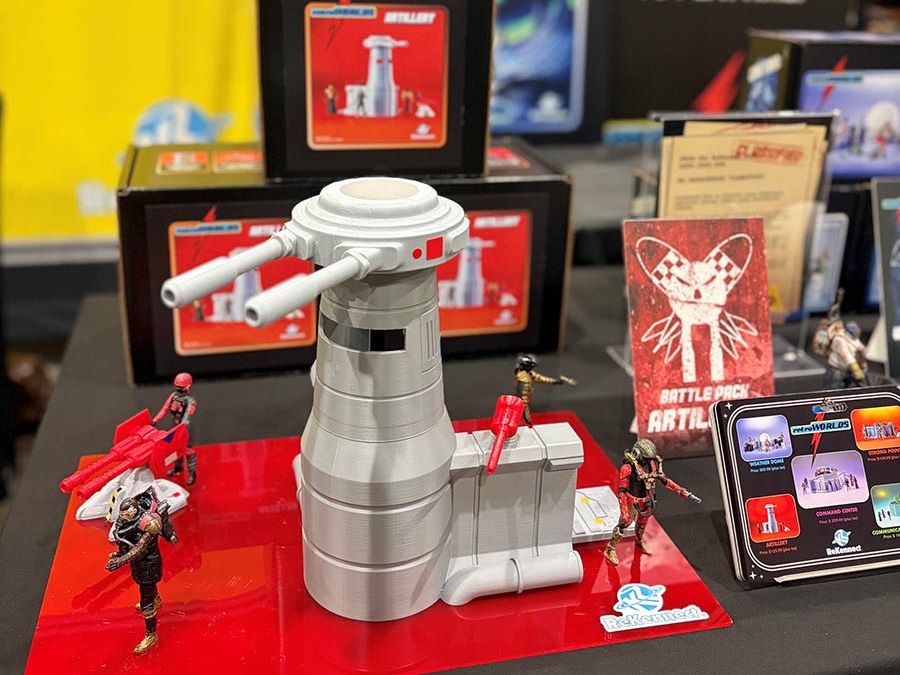
Scoop: It sounds like you put in a lot of work.
RR: Yeah, actually I really wanted this to feel like this was a legitimate startup company. I didn’t want to feel like this is just an Etsy popup. We wanted to make it feel like this is a new company that is very much revering in the nature of what we remembered, but something modern and new that both folks my age and the younger generation could appreciate and enjoy.
Scoop: What are the themes in your Retro Worlds playsets?
RR: The theme is an amalgamation of a lot of inspiration coming from the stuff that I remember growing up with or what we grew up with back in the late ‘70s, early ‘80s, the products that we would see that Kenner, Hasbro, and Mattel would make. Everything from some of the color schemes of our toys being those military greens and reds and grays to the design themselves is a combination of some space fantasy. There’s some real military aesthetics built into our designs and then actual old World War II designs. I actually really enjoy American history, history of the last 50 years, and just looking at inspirations coming off of what I would see just generally around the area where we live. We’re not that far away from NSA. Just seeing some of the satellites and seeing some of the radar equipment from the freeways, seeing some old World War II lookout towers on the sands and beaches in Delaware. I drew from those inspirations and some of those designs and just inserted them into the final products. So, you have real world technology, real world designs with a splattered dash of what we had in the fantasy worlds of the imaginations of Kenner and Hasbro back in the day.
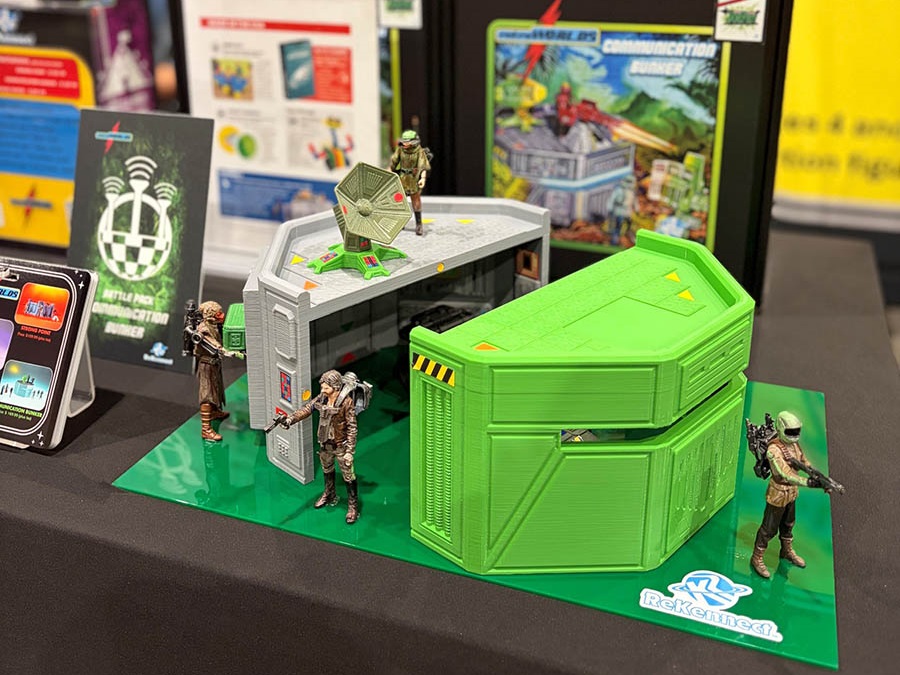
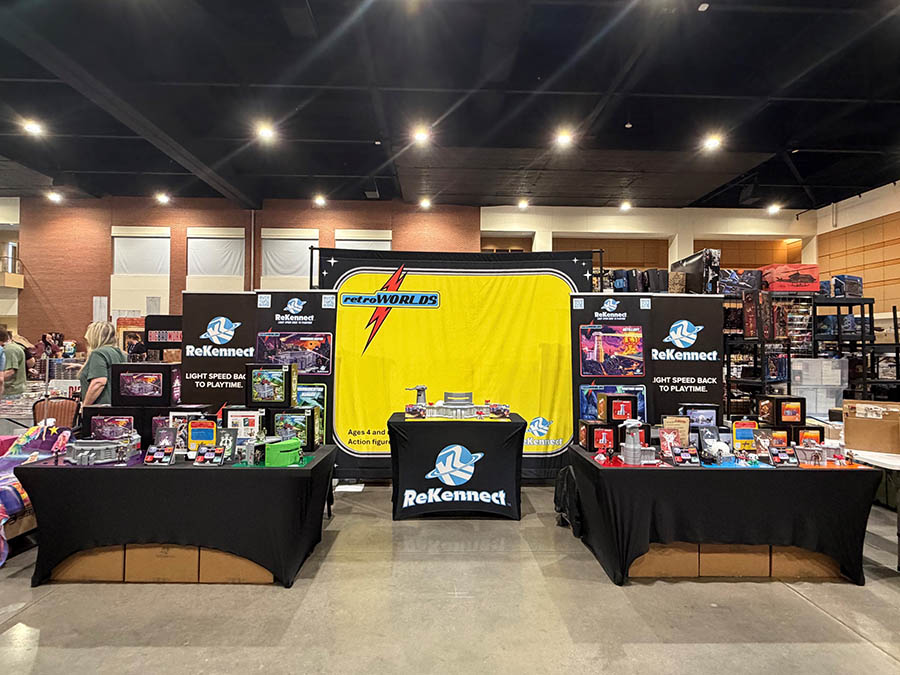
Scoop: Beyond the toys themselves, your convention display and product packaging also has a vintage, 1980s, late ‘70s style. Where did that idea come from and who did the artwork?
RR: Again, everything from our toys to our displays to our packaging, I wanted the essence of ReKennect to feel like you are reconnecting back to your childhood. Our tagline is: Lightspeed back to playtime. Everything about who we are, I wanted to feel like you are feeling the embodiment of a simpler time or a time of a golden era time of toys. Our designs, our influence from our designs, everything from the color patterns to the red, the gold, orange, the green, the blue, the purple. I mean, there’s a lot of inspiration of just the bandanas from the Teenage Mutant Ninja Turtles with their color schemes to identify each one of them independently. The black box, that was straight out of something you would see out of a Star Wars Kenner package.
The illustrations was something I really wanted to bring back. I was always inspired at a young age looking at that G.I. Joe package box or the Masters of the Universe fantasy artwork that I just would see and go, well, I want to be in that world – just off of the box. I was so excited to see that stuff, and I wanted to emulate that for our toys. I’m really proud to say that all of our toy photography, our manufacturing, is domestically done in the States.
I came across this amazing illustrator named John Morrow, who actually went to MICA, Maryland Institute College of Art. He is an amazing illustrator. He’s done stuff for Madonna, Dave Matthews, he did stuff for the Dalai Lama, he’s done stuff for Lucasfilm. I just saw something in what he was doing that brought me back to the illustrations and paintings that I remember from those toy boxes and toy packages. We reached out to him, and I gave him the ideas of what I wanted and every time he’s hit home runs with the packaging. We did the first two illustrations about two years ago for the Command Center and the Communication Bunker. I was just so impressed with that, that I said, I want continuity of all the packaging to feel like what you just did for the last two toy playsets. We commissioned him to do basically the other three. All five sets, all the new packaging will have his artwork on the front of it. And it really shines. I wanted people to stop and be like, “Okay, what is this?” The curiosity of his artwork is enough to bring people over to the booth to say, “What am I looking at? This is really cool.” And I’m just really happy to see that we were able to collaborate with him on that.
Scoop: It’s very smart to evoke that emotion with the artwork before you even get into the actual playsets.
RR: Yes, and when you’re seeing, you know, the stories come out about how certain companies are using AI to create illustrative artwork, I just wanted to eschew from that altogether. I wanted the raw talent of someone picking up the pens and pencils and markers and doing it the way it was done 40, 50 years ago. And he was able to display that in spades.
Scoop: What is next for ReKennect?
RR: What’s next? We are currently working on our next chapter of toy designs right now. I’m actually working on a handful of new playsets, modular playsets. It’s going to continue to have the MagKennect system in it. But I think we’re going a little different from what we saw in the first wave. I feel like a lot of the first wave toys, the color schemes, and the designs sort of have a heroic protagonist type of vibe to them, even though it’s designed for whatever toy line you want. We wanted to go in a contrast from what we did the first time around. So, I kind of analogize, consider this – when I’m talking with the designs and the engineering guys – consider this like the Empire Strikes Back chapter of the next story. We want something that’s a little bit darker in tone. We’re looking at things to incorporate with Greek mythology, bio engineering circuitry, the color scheme, the color palette that we want is something a little bit darker. So maybe some reds, some dark purples, and blacks.
We really were inspired on what we saw with the Micronauts series back in the late ‘70s. We want some stuff that’s translucent, maybe some glow in the dark. We want to invoke that type of aesthetic in this next chapter. We’re looking at the designs to be somewhat alien in nature, not specifically alien from [H.R.] Giger work, but we want to draw from those types of themes, the inspirations of Ron Cobb and what he did in a lot of the sets that he created on some movies, some great blockbusters we remember. We’re looking at all of that and kind of playing with some designs right now. Obviously, it’s going to take some time for us to put the final touches on those in 2D form and then engineer it. But we’re hoping, if we’re ambitious enough, to try and get some tangible prototypes out by the end of the year, but certainly have something presented next year for the shows. They may not be ready for sale, but at least for the supporters and fans and hopefully new fans, we’ll be able to show them what we have in store for them.
Scoop: What conventions are you going to be setting up at in the near future?
RR: We’re going to be at the Hershey Action Figure Toy Show in Hershey, Pennsylvania. I think that’s August 22. We are also looking at, probably, the Maryland Toy Expo in November. We also are looking at some shows outside of the Mid-Atlantic region. Knowing the success that we’ve seen at the Joe Fest conventions the last two years, I think we’re really hoping to try to make Joelanta next year. ZoloCon would be another one that we want to try to be at. And then if there’s anything else that really fits our sort of independent toy maker space, we’re going to look at. But for right now, the first hit is chocolate world of Hershey, PA.
Scoop: Well, thank you so much for doing this interview, and I wish you the best for the future projects you have going on.
RR: Thank you so much, Amanda. I really appreciate your time.
(Photos courtesy of Richard Reinhardt.)

Popular Topics
Overstreet Access Quick Links
ReKennect Founder Richard Reinhardt on Reviving Action Figure Playsets
Toy collectors remember their childhoods fondly, reminiscing about the days when their to do list was playing in the imaginative worlds of their favorite toys. Collectors display their toys and introduce them to new generations, which inspired Richard Reinhardt to create ReKennect. The company founder and CEO took that nostalgia into modern territory by creating new playsets that are compatible with various vintage toy lines and some more recent releases. Reinhardt talked to Scoop about his inspiration for the company, developing the playset line, what it includes, and plans for the future.
Scoop: Let’s start by telling readers what is ReKennect.
Richard Reinhardt (RR): Okay, great first question. ReKennect is a startup Maryland-based toy company. We began this journey almost 12 or 13 years ago. What we are doing is bringing back modular 1/18 scale playsets to the modern day collector, the Gen. X collectors, the Gen. X parents. Also just reviving the old tactile adventure playsets and castles that we grew up with and giving it to the next generation of kids.
Our modular playsets have an aesthetic that looks very similar to what you may have remembered back in the late ‘70s, early ‘80s, whether it was like a Hasbro G.I. Joe playset or something similar to what you would see from the Kenner Star Wars line.
But it’s modernized. It’s not taking carbon copies of those designs. There’s some DNA within our designs that we’ve made, but we’ve made them our own. They’re all independently original designs. And what we find unique about ours is that we don’t use clip-on snaps or hooks or hinges. Our modular playsets are connected, what we call MagKennect. There’s magnets within every playset, so the kid or the collector can build or configure our playsets in any way they want. We always say, “The only limitation is your imagination.”
It’s a world building playset where the individual playset can stand on its own for your adventure or your mission or your display. But if you want to keep on building or creating more, you have the options to make the modular playsets into whatever configuration you want. You can turn it into a bunker, you can turn it into a super fortress. So, there’s a lot of versatility with our toys.
We’re proud to say that not only are we based in Maryland as a domestic toy company startup, but all of our toys are actually produced and manufactured right in Georgia. We take a lot of pride to say that we are a born in the USA – as [Bruce] Springsteen used to say – toy company.
Scoop: What are some of the fun playsets and accessories collectors can purchase?
RR: That’s another great question. We took a lot of time really thinking about the details of each set. We looked at it, we took a lot of time with focus groups, hearing from parents to collectors to kids, what they want, what they remember, some of the things they wish they had, things that they had but could have been better improved in terms of design. We’ve created five separate sets in our first chapter, as we call it.
The first chapter has a small range of, like, an introductory set called the Weather Dome. It’s a little playset that comes with a lot of accessories. The set has a modular dome that actually opens up where it reveals a cache of tons of equipment for your field missions. You’ve got ammo crates that actually open up to store your little action figure weaponry. You’ve got barrels, you’ve got computers, you’ve got weather sensors. And again, the MagKennect system is in every integrated playset. It comes with an artillery cannon and a tripod, and that is connected by magnets. You can dismantle it or make it battle damaged. You can make it move around. The dome, like I said, opens up so you can fill in whatever you want. Whether it’s your action figure accessories or action figures that you have in your toy box, they can load up into one and it can be on its way outside in the sandbox or heading to grandmom’s house for the weekend. You’ve got your own sort of portable playset.
We have a smaller set where you have tons of activities and accessories, and then you scale upward to our most recent Command Center that we launched last year, which is sort of the flagship. The Command Center is the central piece that links all of the other modular playsets together to make this super fortress. And while it’s bigger in scale, you don’t have a lot of accessories, but it comes with a lot of playability. So, the interconnectivity of all the other playsets connect to the central hub of the Command Center, it comes with the MagKennect detachable command computer console. It opens up to reveal two different pieces of the playset where you can put in storage. You can add your armament in the storage rooms, or you can use it as a dungeon if you like. It also comes with an attachment we call the energy walkway, which then attaches to the Weather Dome. So again, everything’s sort of interconnected, but it also depends on the range of the size and the pricing of our sets. The smaller the set, we pack in a lot of accessories and a lot of fun gadgetry. The larger the set, the bigger the playset, but fewer of the accessories.
Scoop: What toy lines would you say are most compatible with your Retro Worlds?
RR: We started out thinking when we were designing our Retro World collection, the 1/18 scale, and we continue to keep that as sort of the toy line size. So, anything that is in your shelf, from your old ‘80s or late ‘70s Micronauts to your Star Wars, to your G.I. Joes, to modern day 1/18 scale independent toys that you see at the cons and whatnot, like a Skeletron or even a Delta 17.
But one of the things that we discovered early on when we launched back four years ago, the Mini Mates community, they’ve really embraced us. Now they’re kind of a size in between Legos and 3-3/4-inch scale. And to our delight, we’ve seen this community really embrace us, they feel that our scale of toys and some of the accessories that come with our toys actually meets the scale for those action figures. They love the sets. They feel like it’s a world building environment for that toy line. If I were to place a size, I would say now Mini Mates would be in that scale, but generally speaking, the 3-3/4-inch, 1/18 scale is where we sit.
Scoop: That’s pretty cool. I didn’t think about the Mini Mates, but that makes sense.
RR: Yeah, we were so delighted. We didn’t even think about it, but one of our first customers purchased the Weather Dome, and they were a big Mini Mates collector, and they just fell in love with the size of the scalability for their environments. And before we knew it, we saw the first couple of our customers were Mini Mates collectors. So, we’re like, wow, this is really great. A nice little hidden surprise we didn’t even see happen. As Bob Ross would say, a happy accident.
Scoop: All kids play with toys, but very few work in the hobby as adults. What has driven your passion for toys from childhood to collecting and working in the industry today?
RR: Great question again. I feel, you know, there’s a connection to my childhood that I think is inherent with all of us in this industry and in this culture, pop culture. I feel like there’s a sense of when you’re holding something tactile, you almost immerse yourself in your own imagination, your own creativity, your own story. You create your own mythology of those toys. And you can’t get that off of a video game or a tablet these days. And I think for me, the inspiration really transcended out of my childhood with my imagination and creativity. I went to art school, and I started to become an actual professional artist and illustrator. I feel like that helped me continue into what I’m doing now.
But I think really part of the inspiration that generated ReKennect came from my nephew. Being the cool godfather that I was, I saw my nephew, at the time about 13 years ago, playing with all my old stuff. And I would go to the toy aisles to find him the new latest castle or command center, and we didn’t really see that. The big toy companies weren’t making that stuff. And so to me, I thought, I want to bring that back to this next generation. I’ve seen parents, with young kids being on the floor, creating little castles and whatnot, and I was doing the same, but I felt that there was a need for us to bring that part of the toy aisle back, that toy line back.
I feel that you can have a wide range of action figures, some really great designs and really great ingenuity now, but the vehicles and the playsets just seem to be lost on the shelves these days. And to me, I feel like you can’t really build a world of playability and creativity and adventure with just an action figure. I thought, well, let’s take this to see where we can explore. And at the time, 3D added manufacturing was sort of becoming a new line of a development in R&D and just taking my art background and some ingenuity, I started to develop a whole sort of toy line and out came ReKennect.
Scoop: How did you build the company once you started getting that ball rolling?
RR: It started out, like I said, with just some simple 2D drawings. Then before I knew it, I was going to the craft store, making this stuff up as I went, using popsicle sticks, and glue guns to kind of develop some 3D shapes. But I don’t have an engineering mind, and I don’t have an engineering background. It was sort of serendipitous at the time of me developing the toy line 2D concepts, I was introduced to my former business partner who had the CAD skills and the engineering skills to take the 2D designs and build them out and make them into something real, and really develop a whole new dimension, no pun intended, to the toy line. We began the first few years taking the concepts, redesigning them, re-engineering them so that they could be playable. Then we took on the stages of, okay, let’s take this out to some focus groups, let’s show these to kids, let’s show this to friends and talk a little bit about it outside our comfort zone with friends and family. Let’s see what other strangers have to say about it.
And then we knew that for me, I wanted to make this a legitimate toy startup company. I had to go through the motions of making sure that our toys were safely tested for toxicity or splintering, same thing with shatter. I wanted to make sure that our stuff was also legally protected if we were ever to see ourselves taking our concepts or ideas to a company outside the States. I wanted to make sure our stuff was protected legally. We went through all of those stages. The R&D process took quite a lot of time, and we were ready to be on the cusp of launching right around 2020 and we all know what happened in 2020. We had the COVID hit and we just kind of shut everything down for about two additional years.
It was sort of an accident again, as Bob Ross would say, happy accident. Through that time of COVID and the pandemic, it was a realization on our part where we saw supply chain issues, we saw costs from overseas and pricing going up on everything. It just made me feel that if I want to do this, I want to make sure that our products are available. I don’t want to do this through a crowdfunding, so I’m going to self-finance this entire company from scratch. And I want to make sure that my company is Maryland is based. It’s here in the States. I want a manufacturer that can do this in the States so that we don’t have to run into any of these problems. It’s sort of a moment of clarity. And it was really, I think, one that I’m really proud to say that we did. Because even now with all the tariff increases, prices of oil going up, plastic costs so much, all the dealings with what I’ve seen with other tribulations with other startups and what they’re dealing with on Kickstarters and whatnot, I’m happy that I just avoided all of that and was able to make it happen. It took a little bit of time to get us there, but the end result, I’m very pleased to say, was the right choice for us.
Scoop: It sounds like you put in a lot of work.
RR: Yeah, actually I really wanted this to feel like this was a legitimate startup company. I didn’t want to feel like this is just an Etsy popup. We wanted to make it feel like this is a new company that is very much revering in the nature of what we remembered, but something modern and new that both folks my age and the younger generation could appreciate and enjoy.
Scoop: What are the themes in your Retro Worlds playsets?
RR: The theme is an amalgamation of a lot of inspiration coming from the stuff that I remember growing up with or what we grew up with back in the late ‘70s, early ‘80s, the products that we would see that Kenner, Hasbro, and Mattel would make. Everything from some of the color schemes of our toys being those military greens and reds and grays to the design themselves is a combination of some space fantasy. There’s some real military aesthetics built into our designs and then actual old World War II designs. I actually really enjoy American history, history of the last 50 years, and just looking at inspirations coming off of what I would see just generally around the area where we live. We’re not that far away from NSA. Just seeing some of the satellites and seeing some of the radar equipment from the freeways, seeing some old World War II lookout towers on the sands and beaches in Delaware. I drew from those inspirations and some of those designs and just inserted them into the final products. So, you have real world technology, real world designs with a splattered dash of what we had in the fantasy worlds of the imaginations of Kenner and Hasbro back in the day.
Scoop: Beyond the toys themselves, your convention display and product packaging also has a vintage, 1980s, late ‘70s style. Where did that idea come from and who did the artwork?
RR: Again, everything from our toys to our displays to our packaging, I wanted the essence of ReKennect to feel like you are reconnecting back to your childhood. Our tagline is: Lightspeed back to playtime. Everything about who we are, I wanted to feel like you are feeling the embodiment of a simpler time or a time of a golden era time of toys. Our designs, our influence from our designs, everything from the color patterns to the red, the gold, orange, the green, the blue, the purple. I mean, there’s a lot of inspiration of just the bandanas from the Teenage Mutant Ninja Turtles with their color schemes to identify each one of them independently. The black box, that was straight out of something you would see out of a Star Wars Kenner package.
The illustrations was something I really wanted to bring back. I was always inspired at a young age looking at that G.I. Joe package box or the Masters of the Universe fantasy artwork that I just would see and go, well, I want to be in that world – just off of the box. I was so excited to see that stuff, and I wanted to emulate that for our toys. I’m really proud to say that all of our toy photography, our manufacturing, is domestically done in the States.
I came across this amazing illustrator named John Morrow, who actually went to MICA, Maryland Institute College of Art. He is an amazing illustrator. He’s done stuff for Madonna, Dave Matthews, he did stuff for the Dalai Lama, he’s done stuff for Lucasfilm. I just saw something in what he was doing that brought me back to the illustrations and paintings that I remember from those toy boxes and toy packages. We reached out to him, and I gave him the ideas of what I wanted and every time he’s hit home runs with the packaging. We did the first two illustrations about two years ago for the Command Center and the Communication Bunker. I was just so impressed with that, that I said, I want continuity of all the packaging to feel like what you just did for the last two toy playsets. We commissioned him to do basically the other three. All five sets, all the new packaging will have his artwork on the front of it. And it really shines. I wanted people to stop and be like, “Okay, what is this?” The curiosity of his artwork is enough to bring people over to the booth to say, “What am I looking at? This is really cool.” And I’m just really happy to see that we were able to collaborate with him on that.
Scoop: It’s very smart to evoke that emotion with the artwork before you even get into the actual playsets.
RR: Yes, and when you’re seeing, you know, the stories come out about how certain companies are using AI to create illustrative artwork, I just wanted to eschew from that altogether. I wanted the raw talent of someone picking up the pens and pencils and markers and doing it the way it was done 40, 50 years ago. And he was able to display that in spades.
Scoop: What is next for ReKennect?
RR: What’s next? We are currently working on our next chapter of toy designs right now. I’m actually working on a handful of new playsets, modular playsets. It’s going to continue to have the MagKennect system in it. But I think we’re going a little different from what we saw in the first wave. I feel like a lot of the first wave toys, the color schemes, and the designs sort of have a heroic protagonist type of vibe to them, even though it’s designed for whatever toy line you want. We wanted to go in a contrast from what we did the first time around. So, I kind of analogize, consider this – when I’m talking with the designs and the engineering guys – consider this like the Empire Strikes Back chapter of the next story. We want something that’s a little bit darker in tone. We’re looking at things to incorporate with Greek mythology, bio engineering circuitry, the color scheme, the color palette that we want is something a little bit darker. So maybe some reds, some dark purples, and blacks.
We really were inspired on what we saw with the Micronauts series back in the late ‘70s. We want some stuff that’s translucent, maybe some glow in the dark. We want to invoke that type of aesthetic in this next chapter. We’re looking at the designs to be somewhat alien in nature, not specifically alien from [H.R.] Giger work, but we want to draw from those types of themes, the inspirations of Ron Cobb and what he did in a lot of the sets that he created on some movies, some great blockbusters we remember. We’re looking at all of that and kind of playing with some designs right now. Obviously, it’s going to take some time for us to put the final touches on those in 2D form and then engineer it. But we’re hoping, if we’re ambitious enough, to try and get some tangible prototypes out by the end of the year, but certainly have something presented next year for the shows. They may not be ready for sale, but at least for the supporters and fans and hopefully new fans, we’ll be able to show them what we have in store for them.
Scoop: What conventions are you going to be setting up at in the near future?
RR: We’re going to be at the Hershey Action Figure Toy Show in Hershey, Pennsylvania. I think that’s August 22. We are also looking at, probably, the Maryland Toy Expo in November. We also are looking at some shows outside of the Mid-Atlantic region. Knowing the success that we’ve seen at the Joe Fest conventions the last two years, I think we’re really hoping to try to make Joelanta next year. ZoloCon would be another one that we want to try to be at. And then if there’s anything else that really fits our sort of independent toy maker space, we’re going to look at. But for right now, the first hit is chocolate world of Hershey, PA.
Scoop: Well, thank you so much for doing this interview, and I wish you the best for the future projects you have going on.
RR: Thank you so much, Amanda. I really appreciate your time.
(Photos courtesy of Richard Reinhardt.)
Popular Topics
Overstreet Access Quick Links