



Mattel Electronics Auto Race Speeds Up the Track
Mattel Electronics Auto Race, released in 1976, is one of the earliest handheld games. It features a three-lane track where the player attempts to complete a race in the shortest time possible while avoiding other vehicles on the road. It was the first handheld electronic game that used solid state electronics, which means that the only mechanical elements are the controls and the on/off switch.
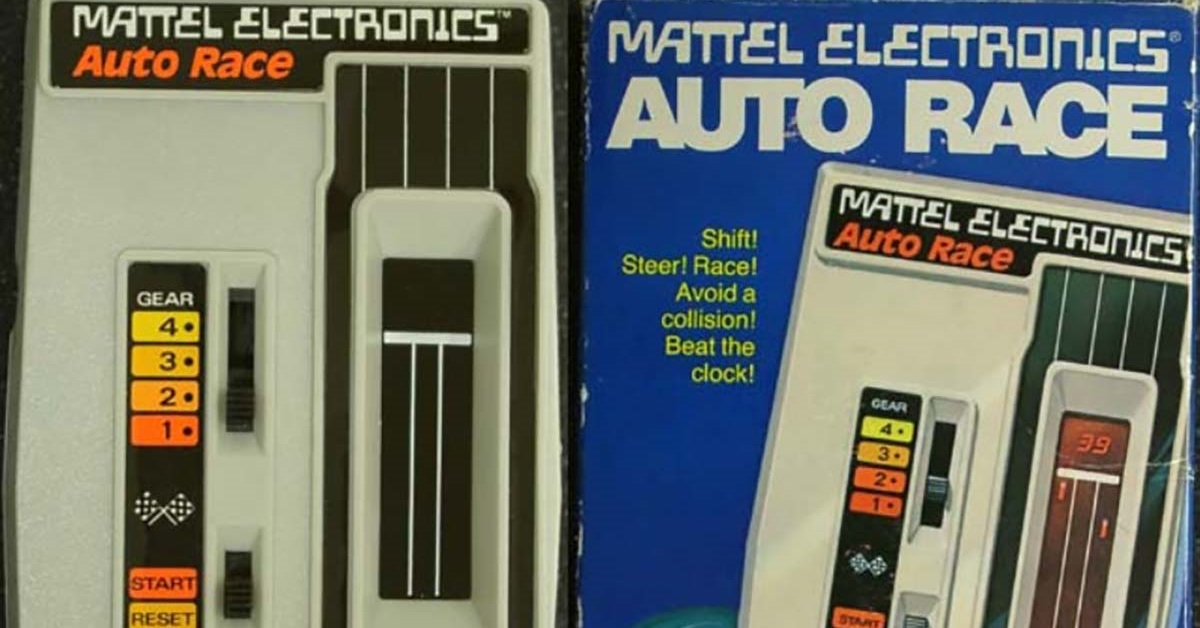
The Auto Race electronic screen shows the three-lane track on the right side of the device with a steering toggle switch beneath the screen. The left side of the handheld has a switch that moves the speed from first to fourth gear. A speaker that emits beeping sounds is set below the gear shift switch.
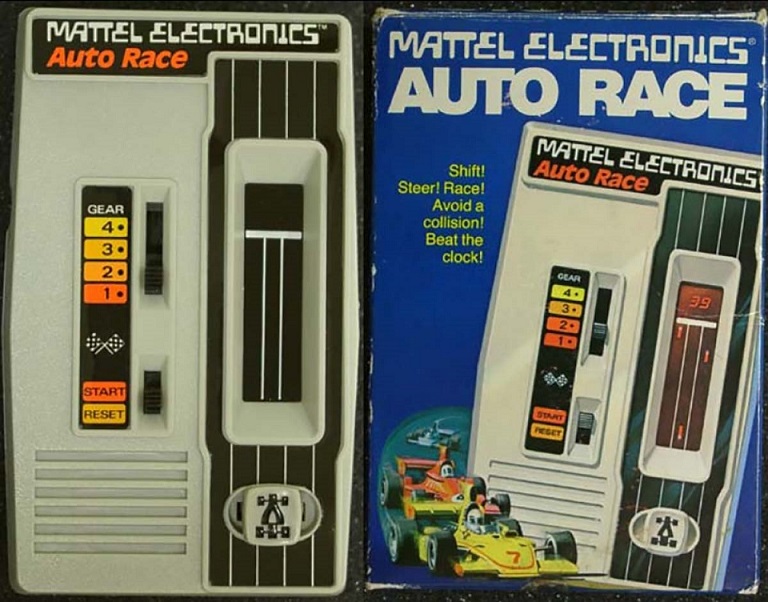
The player’s car appears as a bright vertical dash sign on the bottom of the screen and their goal is to travel to the top of the screen four times (representing four laps). While doing so, they must change lanes to avoid hitting other cars that come toward the player’s car through vertical scrolling. If the player’s car gets hit, it will be pushed back down the screen until the player maneuvers around the other car.
The game was created by George J. Klose, a Mattel product development engineer who figured out how to repurpose the hardware from calculators to create a handheld electronic game. He used the individual display segments as blips that could move on the display, then took inspiration from racing games in arcades to develop Mattel Auto Race. Klose built a proof of concept device with a blip moving on an LED screen (minus the microprocessor) to show Mattel his idea.
Once it was approved, Klose and his manager, Richard Cheng, contacted the Microelectronics Division of Rockwell International to create a small circuit board. They worked with circuit design engineer Mark Lesser, who upgraded the B5000 calculator chip by giving the hardware a display driver multiplexing scheme and a custom sound driver.
The Mattel Auto Racer was a big success when it hit the market, despite the-then expensive price of $24.99 (about $140 today). It was so popular, that Mattel quickly developed Mattel Football, which sold out quickly when that hit store shelves. The success of both games prompted Mattel to create the Mattel Electronics Division in 1978.
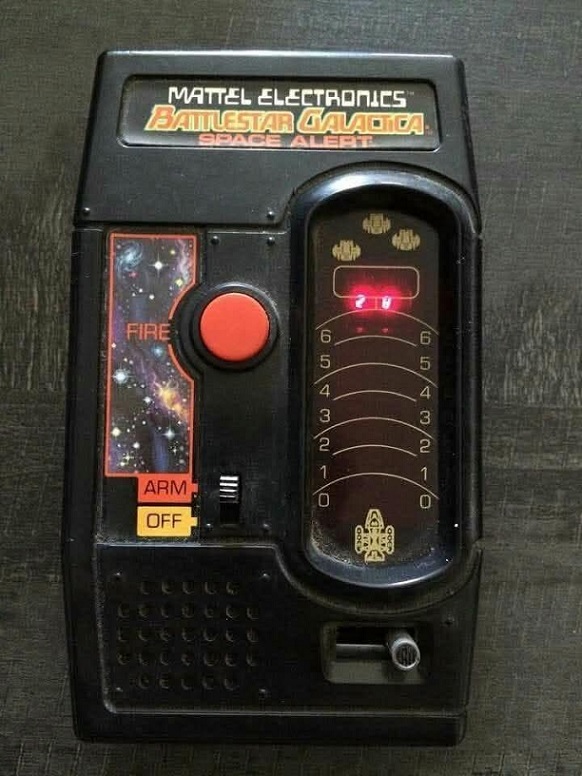
Mattel released more sports-themed games for baseball, basketball, hockey, and soccer. In ’76, they had reworked Auto Race as Missile Attack, but it was considered too dark at the time. Two years later, they revamped it again as Battlestar Galactica Space Alert based on the popular science fiction show. In that game, the player at the bottom of the screen shoots at their enemy to keep the adversary from reaching them and destroying the Galactica.

Popular Topics
Overstreet Access Quick Links
Mattel Electronics Auto Race Speeds Up the Track
Mattel Electronics Auto Race, released in 1976, is one of the earliest handheld games. It features a three-lane track where the player attempts to complete a race in the shortest time possible while avoiding other vehicles on the road. It was the first handheld electronic game that used solid state electronics, which means that the only mechanical elements are the controls and the on/off switch.
The Auto Race electronic screen shows the three-lane track on the right side of the device with a steering toggle switch beneath the screen. The left side of the handheld has a switch that moves the speed from first to fourth gear. A speaker that emits beeping sounds is set below the gear shift switch.
The player’s car appears as a bright vertical dash sign on the bottom of the screen and their goal is to travel to the top of the screen four times (representing four laps). While doing so, they must change lanes to avoid hitting other cars that come toward the player’s car through vertical scrolling. If the player’s car gets hit, it will be pushed back down the screen until the player maneuvers around the other car.
The game was created by George J. Klose, a Mattel product development engineer who figured out how to repurpose the hardware from calculators to create a handheld electronic game. He used the individual display segments as blips that could move on the display, then took inspiration from racing games in arcades to develop Mattel Auto Race. Klose built a proof of concept device with a blip moving on an LED screen (minus the microprocessor) to show Mattel his idea.
Once it was approved, Klose and his manager, Richard Cheng, contacted the Microelectronics Division of Rockwell International to create a small circuit board. They worked with circuit design engineer Mark Lesser, who upgraded the B5000 calculator chip by giving the hardware a display driver multiplexing scheme and a custom sound driver.
The Mattel Auto Racer was a big success when it hit the market, despite the-then expensive price of $24.99 (about $140 today). It was so popular, that Mattel quickly developed Mattel Football, which sold out quickly when that hit store shelves. The success of both games prompted Mattel to create the Mattel Electronics Division in 1978.
Mattel released more sports-themed games for baseball, basketball, hockey, and soccer. In ’76, they had reworked Auto Race as Missile Attack, but it was considered too dark at the time. Two years later, they revamped it again as Battlestar Galactica Space Alert based on the popular science fiction show. In that game, the player at the bottom of the screen shoots at their enemy to keep the adversary from reaching them and destroying the Galactica.
Popular Topics
Overstreet Access Quick Links