



Inside the Guide: Trouble

There are a lot of contemporary board games based on the classic Parcheesi (or Pachisi) – cross and circle style games that have been made simpler and easier to understand for younger players. One of the most successful of these has been Trouble, known elsewhere around the world as Frustration or as Kimble.
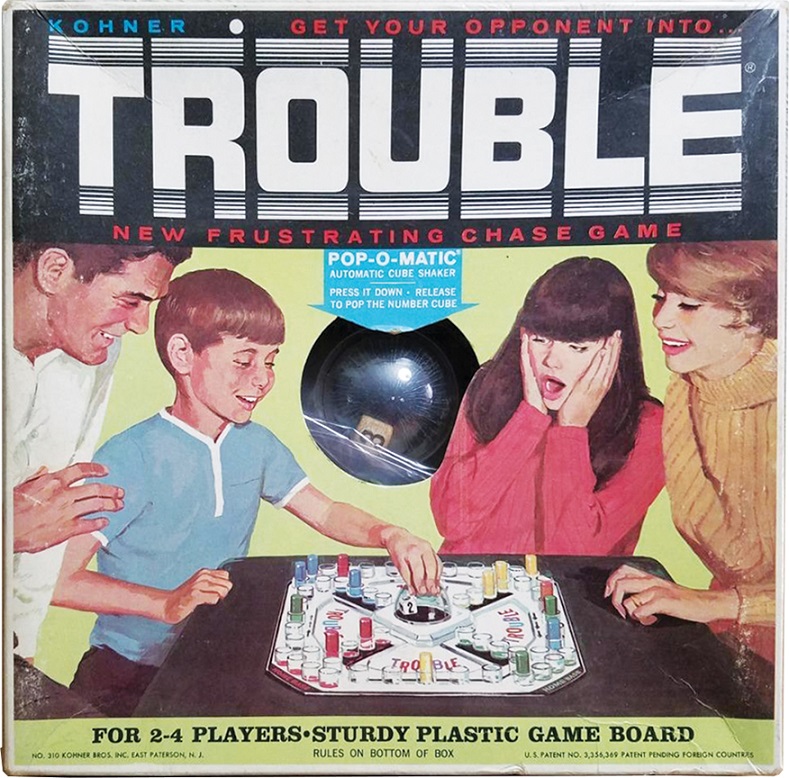
Trouble was originally developed by the Kohner Brothers Company, run by Frank and Paul Kohner. The brothers had previously worked in toy making in the post-World War II era, ranging from simplistic wooden string toys to push-button puppets of licensed properties such as Howdy Doody. Trouble was first launched in 1965; it was later distributed by Milton Bradley, a company which in turn was purchased by Hasbro.
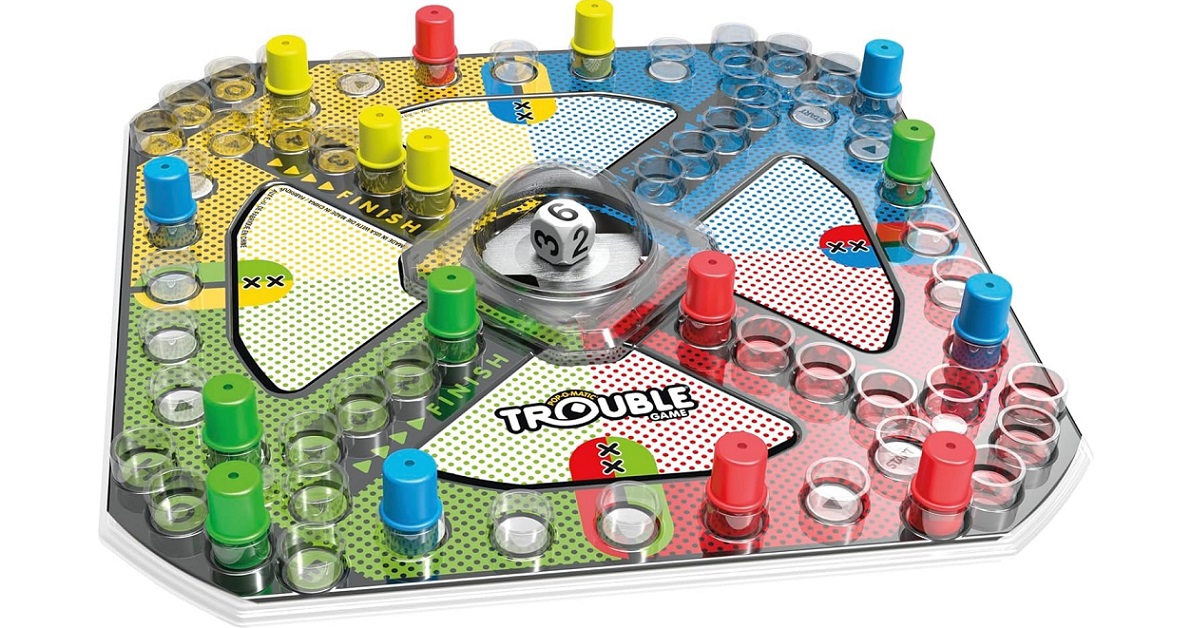
Extremely similar to Sorry!, Trouble is for two to four players with each player represented by color pawns. Starting with their color pawns in the Home area, players must roll a six on the die located in the center of the board to begin moving around the track. All of the pawns must travel the entire way around the board via die rolls and reach the Finish lane in order for a player to win.
Players can bump another player’s pawn by landing on them. Bumped pawns are sent back to their Home area on the board (however, a variant of this rule places the bumped pawn back at the Start area outside of Home in order to bypass the time it would take to try and roll a six again).
What made Trouble a standout when it released (and popular among younger players) was the Pop-O-Matic die container. The clear plastic bubble contains the die and is used to quicken the pace of play by keeping the die in a small enclosed space as well as ensuring that all rolls are fair; for younger players, it also helps to make sure that the small die itself never gets lost and is always contained with the game. The Pop-O-Matic bubble also produces the trademark satisfying pop noise each time it’s pressed.
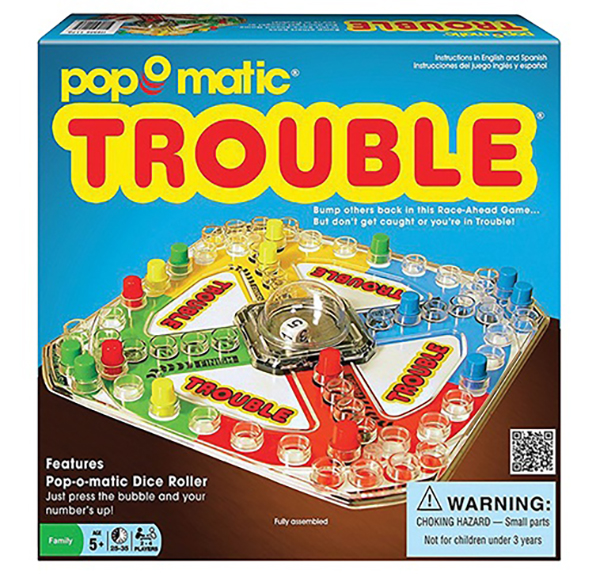
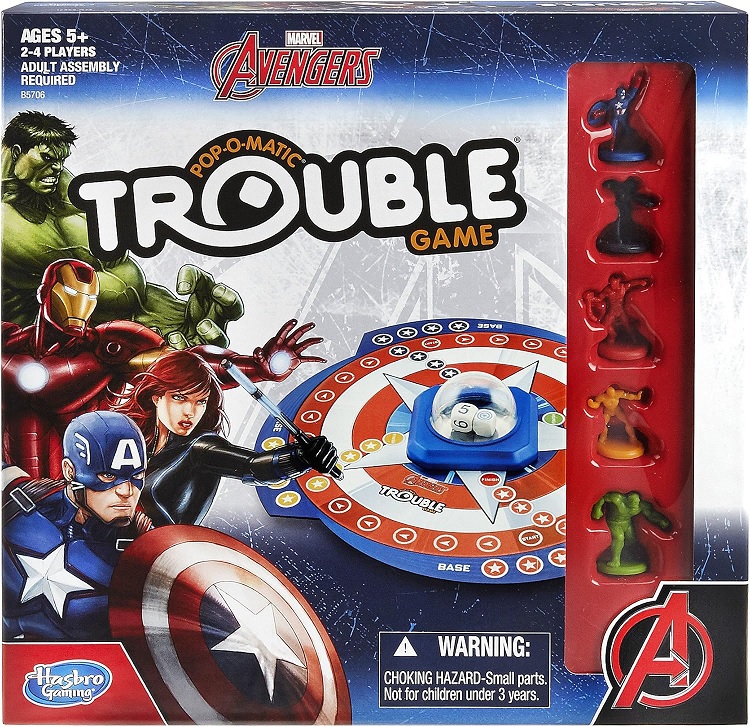
Like many board games aimed at children, Trouble has seen a number of variations released over the years, all themed to different films and other properties. These have included a number of Disney properties, such as Frozen, Cars, and Toy Story, as well as other series such as Despicable Me and SpongeBob SquarePants. There have also been a couple of Star Wars-themed releases: one themed to the Clone Wars animated series (which featured an R2-D2 figure in the Pop-O-Matic and a sound chip that would appropriately beep when pushed) and another themed to The Force Awakens. Both feature a detailed game board with themed character pawn pieces.
Most editions of Trouble can be found for about $10-15. Themed editions usually run a little more, usually ranging between $20-30, though some particularly popular properties (such as Star Wars) can garner prices upwards of $50 or more.

Popular Topics
Overstreet Access Quick Links
Inside the Guide: Trouble
There are a lot of contemporary board games based on the classic Parcheesi (or Pachisi) – cross and circle style games that have been made simpler and easier to understand for younger players. One of the most successful of these has been Trouble, known elsewhere around the world as Frustration or as Kimble.
Trouble was originally developed by the Kohner Brothers Company, run by Frank and Paul Kohner. The brothers had previously worked in toy making in the post-World War II era, ranging from simplistic wooden string toys to push-button puppets of licensed properties such as Howdy Doody. Trouble was first launched in 1965; it was later distributed by Milton Bradley, a company which in turn was purchased by Hasbro.
Extremely similar to Sorry!, Trouble is for two to four players with each player represented by color pawns. Starting with their color pawns in the Home area, players must roll a six on the die located in the center of the board to begin moving around the track. All of the pawns must travel the entire way around the board via die rolls and reach the Finish lane in order for a player to win.
Players can bump another player’s pawn by landing on them. Bumped pawns are sent back to their Home area on the board (however, a variant of this rule places the bumped pawn back at the Start area outside of Home in order to bypass the time it would take to try and roll a six again).
What made Trouble a standout when it released (and popular among younger players) was the Pop-O-Matic die container. The clear plastic bubble contains the die and is used to quicken the pace of play by keeping the die in a small enclosed space as well as ensuring that all rolls are fair; for younger players, it also helps to make sure that the small die itself never gets lost and is always contained with the game. The Pop-O-Matic bubble also produces the trademark satisfying pop noise each time it’s pressed.
Like many board games aimed at children, Trouble has seen a number of variations released over the years, all themed to different films and other properties. These have included a number of Disney properties, such as Frozen, Cars, and Toy Story, as well as other series such as Despicable Me and SpongeBob SquarePants. There have also been a couple of Star Wars-themed releases: one themed to the Clone Wars animated series (which featured an R2-D2 figure in the Pop-O-Matic and a sound chip that would appropriately beep when pushed) and another themed to The Force Awakens. Both feature a detailed game board with themed character pawn pieces.
Most editions of Trouble can be found for about $10-15. Themed editions usually run a little more, usually ranging between $20-30, though some particularly popular properties (such as Star Wars) can garner prices upwards of $50 or more.
Popular Topics
Overstreet Access Quick Links