



Felix the Cat in the Spotlight
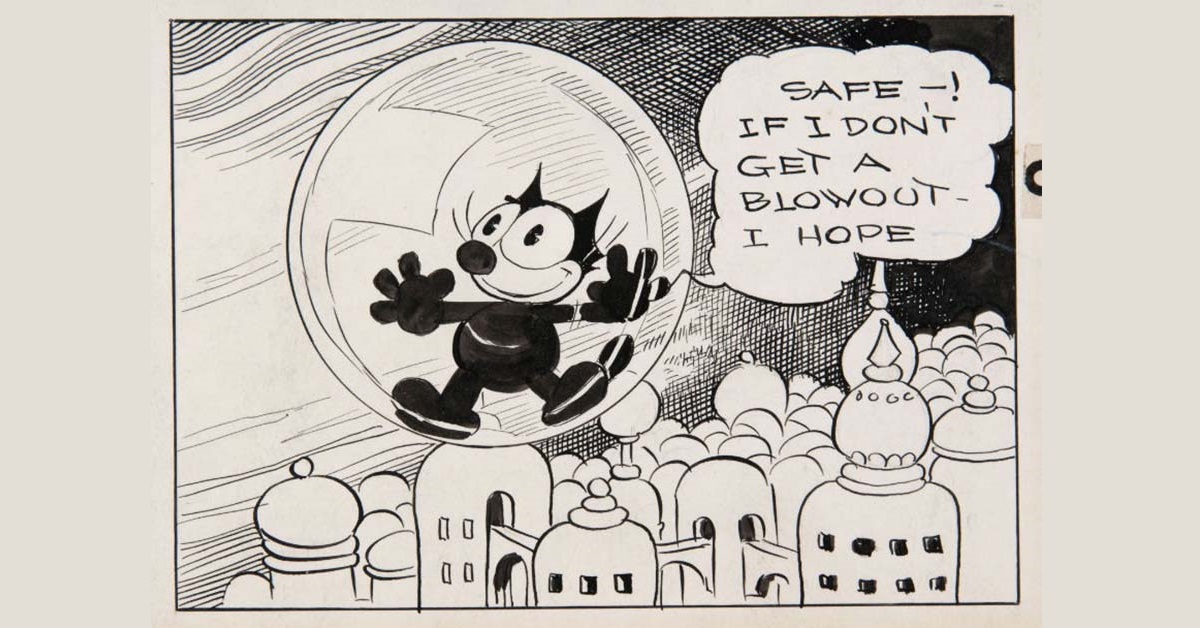
With his black body, huge white eyes and a grin from ear to ear, Felix the Cat is a feline one cannot forget. Making his debut on November 9, 1919, in Paramount Pictures’ Feline Follies, this was his start to becoming one of the most recognized cartoon characters in the world. Due to the silent films monumental success, The Musical Mews and The Adventures of Felix were created within the next couple of months.

Subsequently, Felix moved to print in 1923, further amplifying Felix’s celebrity throughout the United States and abroad. Distributed by King Features, Felix became the starring role in his own comic strip. Due to Felix’s comic strip’s distribution and promotion, various merchandise was stamped with the famous feline. Felix could be found on clocks, Christmas ornaments, postcards, ceramics, toys, and even as the first balloon in Macy’s Thanksgiving Day Parade.
Also during this period, from 1922 to 1925, Educational Pictures continued to distribute Felix cartoons. He mirrored the “Roaring Twenties” with the use of flappers, revealed ethnic stereotypes, became involved with union organizing, performed the Charleston, familiarized himself with celebrities, and shared his thoughts on prohibition.

In 1929 it was decided that Felix would finally make the leap to cartoons with sound. Copley Pictures initiated the venture but fell short of their goal and the series ceased production in 1930. Felix returned to the screen in 1928, but in a very unusual way. For approximately two hours each day, for over a decade, RCA utilized a Felix the Cat doll to help the studio fine-tune the pictures’ definition. The Felix doll was perfect for the job opening; he was black and white and could stand the excruciating heat produced from the studio lights.
After living a low profile life for a few years, television resurrected Felix’s career with the creation of new cartoons which began airing in 1953. A total of 264 five-minute episodes were produced for Trans-Lux TV. Felix’s well-known “Magic Bag of Tricks” was created at this time, as well as his friend Skiddoo the Mouse, his master Willie Brown, and his nephews Inky, Dinky, and Winky. These cartoons were so popular that they continued to air continuously for the next 20 years.


Popular Topics
Overstreet Access Quick Links
Felix the Cat in the Spotlight
With his black body, huge white eyes and a grin from ear to ear, Felix the Cat is a feline one cannot forget. Making his debut on November 9, 1919, in Paramount Pictures’ Feline Follies, this was his start to becoming one of the most recognized cartoon characters in the world. Due to the silent films monumental success, The Musical Mews and The Adventures of Felix were created within the next couple of months.
Subsequently, Felix moved to print in 1923, further amplifying Felix’s celebrity throughout the United States and abroad. Distributed by King Features, Felix became the starring role in his own comic strip. Due to Felix’s comic strip’s distribution and promotion, various merchandise was stamped with the famous feline. Felix could be found on clocks, Christmas ornaments, postcards, ceramics, toys, and even as the first balloon in Macy’s Thanksgiving Day Parade.
Also during this period, from 1922 to 1925, Educational Pictures continued to distribute Felix cartoons. He mirrored the “Roaring Twenties” with the use of flappers, revealed ethnic stereotypes, became involved with union organizing, performed the Charleston, familiarized himself with celebrities, and shared his thoughts on prohibition.
In 1929 it was decided that Felix would finally make the leap to cartoons with sound. Copley Pictures initiated the venture but fell short of their goal and the series ceased production in 1930. Felix returned to the screen in 1928, but in a very unusual way. For approximately two hours each day, for over a decade, RCA utilized a Felix the Cat doll to help the studio fine-tune the pictures’ definition. The Felix doll was perfect for the job opening; he was black and white and could stand the excruciating heat produced from the studio lights.
After living a low profile life for a few years, television resurrected Felix’s career with the creation of new cartoons which began airing in 1953. A total of 264 five-minute episodes were produced for Trans-Lux TV. Felix’s well-known “Magic Bag of Tricks” was created at this time, as well as his friend Skiddoo the Mouse, his master Willie Brown, and his nephews Inky, Dinky, and Winky. These cartoons were so popular that they continued to air continuously for the next 20 years.
Popular Topics
Overstreet Access Quick Links