



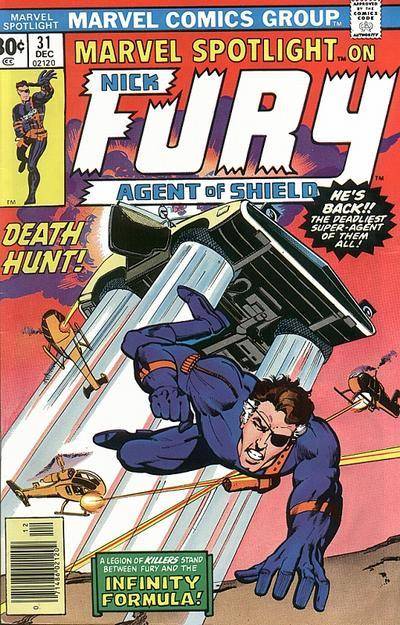
RETRO REVIEW: Marvel Spotlight #31
Marvel Comics; 30¢
From the period in which the greatest generation aged toward their golden years until the Samuel L. Jackson era firmly took hold in the Marvel Cinematic Universe, one of the most frequently asked questions in the original Marvel universe revolved around super spy Nick Fury.
How was a guy who was already a grizzled veteran during World War II still so highly active in the 1970s (let alone in the years that followed)?
Marvel Spotlight #31 (December 1976) has the answer!
Origin
Nick Fury first appeared in Sgt. Fury #1 (cover-dated May 1963). Created by Stan Lee and Jack Kirby, this Marvel Comics title may have lacked the grit and storytelling depth of DC's war titles, but its strong characters gave it a place alongside the company's other offerings.
The series followed Sgt. Nicholas Fury and his World War II unit known as the Howling Commandos. In typical Marvel style for the period, the multi-national unit was comprised of memorable characters who regularly triumphed against the odds.
Though the series would continue, it did not always feature new material. Sgt. Fury #80 (September 1970) was the first reprint issue, and further reprints appeared intermittently until the final original issue, Sgt. Fury #120 (July 1974). At that point, the title also changed, something only those who read the indicia would have noticed.
Although the cover had always read "Sgt. Fury and His Howling Commandos," up until issue 121, the indicia only said "Sgt. Fury." Accordingly, from an Overstreet perspective, Sgt. Fury and His Howling Commandos begins with issue 121 (September 1974) and ends with issue 167 (December 1981), all of which are reprints, and its technically a separate title from the first 120 issues.
The Spy
As the James Bond films and a deluge of other spy movies kicked into high gear at the box office and The Man From U.N.C.L.E. lit up TV screens, it didn't take long for Lee and Kirby to address what Fury would be doing in their then-modern era.
An older, espionage-oriented version of Fury appeared in Fantastic Four #21 (December 1963), just seven months after Sgt. Fury made his first appearance. In that story, he was a CIA agent.
S.H.I.E.L.D. made its debut in Strange Tales #135 (August 1965), and Fury became its director, as the agency was created to battle the forces of Hydra. The S.H.I.E.L.D. stories shared the series with co-feature Doctor Strange through Strange Tales #168 (May 1968). The following issue became Doctor Strange #169 just as Nick Fury, Agent of S.H.I.E.L.D. #1 (June 1968) was launched as its own series.
New stories in the series ran through Nick Fury, Agent of S.H.I.E.L.D. #15, while the final three issues, #16–18, featured reprints of the Strange Tales material. As the series ended, though, Fury did not fade into obscurity. Instead, he and his agency continued to appear in Captain America,
The Avengers, The Defenders, and throughout the Marvel universe.
Marvel Spotlight
The first volume of Marvel Spotlight had begun with a one-shot featuring Red Wolf. It then hosted three issues of Werewolf By Night, became home for Ghost Rider for seven issues (including his origin in issue 5), and then Son of Satan for 13 issues. From Marvel Spotlight #25 through the end of the run, excepting a two-issue stint for Moon Knight, the title rattled off a series of one-shots, most of them very intriguing.
The answer to the biggest mystery around Nick Fury was one of them.
The Story
In the earliest days of S.H.I.E.L.D. stories, the tales were being told only about 20 years after World War II concluded. It made sense that a character like Fury would have continued to serve and to move up the ranks, doing what needed to be done. But since time generally passes very differently in comics than it does in reality, and the final days of the war got further and further away, something had to explain how Fury could keep so spry as his counterparts aged.
Writer Jim Starlin and artist Howard Chaykin answered the question and solved a problem for Marvel with this one-shot story.
During a routine mission through the French countryside at the height of World War II, Fury stumbled into a minefield and was critically injured. He would have died right there in France if a group of partisans hadn't brought him to one Doctor Sternberg for treatment. While treating him, Sternberg used Fury as a guinea pig for an experimental serum that greatly retarded the aging process.
The 1970s had seen the spy-film craze turn at least slightly more cynical, and this tale definitely captured a bit of that flavor. There was a downside to the serum Fury was given: Once taken, the patient was permanently addicted to it. As a result, The Director of S.H.I.E.L.D. was ripe for blackmail.
This story packed a tremendous amount of intrigue, action, and backstory into a standard size, single issue comic book, and it stands up well today. For fans of the character, this is definitely worth seeking out.
Worth Noting
It would seem more than a bit off to mention Fury without talking about the legacy of Jim Steranko. His association with the character began with him inking Kirby's layouts on Strange Tales #151 (December 1966). He assumed full penciling with issue 153, and took over the writing with issue 155 through the end of that series with Strange Tales #168 (May 1968). He wrote and illustrated Nick Fury, Agent of S.H.I.E.L.D. #1-3 and #5 (June-October 1968) and also provided covers for issues 4, 6, and 7. In such a relatively short span – about two years – he created material that elevated storytelling and the perception of the art form. While thoroughly steeped in the spy craze of that era, the work is immediately still recognizable as both ground-breaking and thought-provoking today. This issue fits in well with their tone.
– J.C. Vaughn

Popular Topics
Overstreet Access Quick Links
RETRO REVIEW: Marvel Spotlight #31
Marvel Comics; 30¢
From the period in which the greatest generation aged toward their golden years until the Samuel L. Jackson era firmly took hold in the Marvel Cinematic Universe, one of the most frequently asked questions in the original Marvel universe revolved around super spy Nick Fury.
How was a guy who was already a grizzled veteran during World War II still so highly active in the 1970s (let alone in the years that followed)?
Marvel Spotlight #31 (December 1976) has the answer!
Origin
Nick Fury first appeared in Sgt. Fury #1 (cover-dated May 1963). Created by Stan Lee and Jack Kirby, this Marvel Comics title may have lacked the grit and storytelling depth of DC's war titles, but its strong characters gave it a place alongside the company's other offerings.
The series followed Sgt. Nicholas Fury and his World War II unit known as the Howling Commandos. In typical Marvel style for the period, the multi-national unit was comprised of memorable characters who regularly triumphed against the odds.
Though the series would continue, it did not always feature new material. Sgt. Fury #80 (September 1970) was the first reprint issue, and further reprints appeared intermittently until the final original issue, Sgt. Fury #120 (July 1974). At that point, the title also changed, something only those who read the indicia would have noticed.
Although the cover had always read "Sgt. Fury and His Howling Commandos," up until issue 121, the indicia only said "Sgt. Fury." Accordingly, from an Overstreet perspective, Sgt. Fury and His Howling Commandos begins with issue 121 (September 1974) and ends with issue 167 (December 1981), all of which are reprints, and its technically a separate title from the first 120 issues.
The Spy
As the James Bond films and a deluge of other spy movies kicked into high gear at the box office and The Man From U.N.C.L.E. lit up TV screens, it didn't take long for Lee and Kirby to address what Fury would be doing in their then-modern era.
An older, espionage-oriented version of Fury appeared in Fantastic Four #21 (December 1963), just seven months after Sgt. Fury made his first appearance. In that story, he was a CIA agent.
S.H.I.E.L.D. made its debut in Strange Tales #135 (August 1965), and Fury became its director, as the agency was created to battle the forces of Hydra. The S.H.I.E.L.D. stories shared the series with co-feature Doctor Strange through Strange Tales #168 (May 1968). The following issue became Doctor Strange #169 just as Nick Fury, Agent of S.H.I.E.L.D. #1 (June 1968) was launched as its own series.
New stories in the series ran through Nick Fury, Agent of S.H.I.E.L.D. #15, while the final three issues, #16–18, featured reprints of the Strange Tales material. As the series ended, though, Fury did not fade into obscurity. Instead, he and his agency continued to appear in Captain America,
The Avengers, The Defenders, and throughout the Marvel universe.
Marvel Spotlight
The first volume of Marvel Spotlight had begun with a one-shot featuring Red Wolf. It then hosted three issues of Werewolf By Night, became home for Ghost Rider for seven issues (including his origin in issue 5), and then Son of Satan for 13 issues. From Marvel Spotlight #25 through the end of the run, excepting a two-issue stint for Moon Knight, the title rattled off a series of one-shots, most of them very intriguing.
The answer to the biggest mystery around Nick Fury was one of them.
The Story
In the earliest days of S.H.I.E.L.D. stories, the tales were being told only about 20 years after World War II concluded. It made sense that a character like Fury would have continued to serve and to move up the ranks, doing what needed to be done. But since time generally passes very differently in comics than it does in reality, and the final days of the war got further and further away, something had to explain how Fury could keep so spry as his counterparts aged.
Writer Jim Starlin and artist Howard Chaykin answered the question and solved a problem for Marvel with this one-shot story.
During a routine mission through the French countryside at the height of World War II, Fury stumbled into a minefield and was critically injured. He would have died right there in France if a group of partisans hadn't brought him to one Doctor Sternberg for treatment. While treating him, Sternberg used Fury as a guinea pig for an experimental serum that greatly retarded the aging process.
The 1970s had seen the spy-film craze turn at least slightly more cynical, and this tale definitely captured a bit of that flavor. There was a downside to the serum Fury was given: Once taken, the patient was permanently addicted to it. As a result, The Director of S.H.I.E.L.D. was ripe for blackmail.
This story packed a tremendous amount of intrigue, action, and backstory into a standard size, single issue comic book, and it stands up well today. For fans of the character, this is definitely worth seeking out.
Worth Noting
It would seem more than a bit off to mention Fury without talking about the legacy of Jim Steranko. His association with the character began with him inking Kirby's layouts on Strange Tales #151 (December 1966). He assumed full penciling with issue 153, and took over the writing with issue 155 through the end of that series with Strange Tales #168 (May 1968). He wrote and illustrated Nick Fury, Agent of S.H.I.E.L.D. #1-3 and #5 (June-October 1968) and also provided covers for issues 4, 6, and 7. In such a relatively short span – about two years – he created material that elevated storytelling and the perception of the art form. While thoroughly steeped in the spy craze of that era, the work is immediately still recognizable as both ground-breaking and thought-provoking today. This issue fits in well with their tone.
– J.C. Vaughn
Popular Topics
Overstreet Access Quick Links