



RETRO REVIEW: Mister X: The Archives
Dark Horse Comics; $79.95
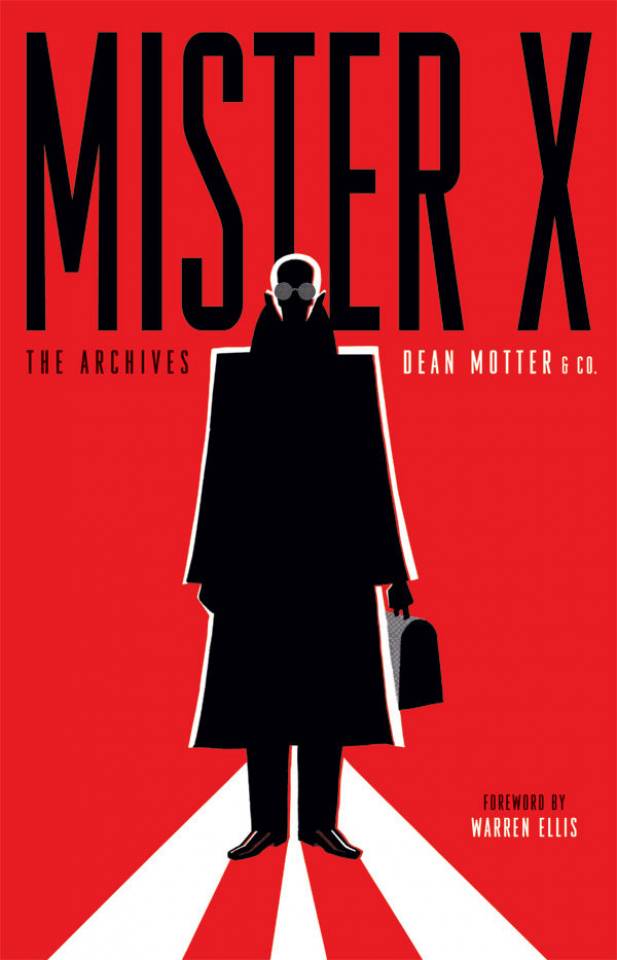
On any list of distinctive, game-changing works comic book works from the 1980s must be Dean Motter's Mister X, a brilliant blend of crisp design sensibilities, early German cinema, the art deco movement, and the concept of "retro futurism" and mysteries wrapped in further mysteries. Originally published by Vortex in 14 issues from June 1984 through August 1988, this collection was published by Dark Horse in hardcover in November 2008.
The 1980s
While just about every age has something to recommend it, for the sheer power of creativity and newness of the possibilities in a specific comic book era, it's hard to beat the '80s. It's difficult to look past this creator-centric period because it was simply awash in cool concepts from writers and artists who believed the medium had more to offer than had been asked of it previously.
Pioneers like Will Eisner and Don McGregor had hit us with their graphic novels in the 1970s, but it was the '80s that gave us Howard Chaykin's American Flagg, Mike Baron and Steve Rude's Nexus, Dave Stevens' The Rocketeer, Matt Wagner's Grendel, Mark Wheatley and Marc Hempel's Mars, Mike Grell's Jon Sable, Freelance, Kevin Eastman and Peter Laird's Teenage Mutant Ninja Turtles, Doug Moench's Aztec Ace, and Bill Willingham's The Elementals, among many others.
Retro-Futurism
Retro-futurism can be defined as a style or storytelling approach that imagines the future through the technological, architectural, and cultural expectations of an earlier era. It takes what people of a certain era thought the future might be like and plays it out as if things actually happened that way.
This combination of fact and fantasy has given us story elements such as vacuum tubes, analog controls, streamlined automobiles, atomic age architecture integrated into advanced robots, spacecraft, ray guns, or artificial intelligence. Whether in video games like Fallout, cartoons like Batman: The Animated Series, or comics like Hellboy, elements of retro-futurism have successfully infiltrated much of pop culture.
The Story
A man of mystery, Mister X returns to Radiant City, a sprawling story set in Radiant City, a metropolis conceived as an architectural marvel but one that fell far short of its intended glory. The title character seeks to repair what has gone wrong with the city's "psychetecture" – the ability of the physical architecture to seriously impact its residents' psychological health.
In the light of the rampant and increasing instances of insanity, insomnia, addiction and social decay, it seems that he might very well be on to something. But Mister X is also a man of contractions. He keeps himself awake with the drug Insomnalin, which makes him unstable like the citizens he hopes to save.
Giving form to these concepts was dazzling arrays of artistic talent: Paul Rivoche, Los Bros. Hernandez, Klaus Schönefeld, Seth, Ty Templeton, and Motter himself were supplemented by the likes of Dave McKean, Bill Sienkiewicz, and others.
Throughout the series, Motter kept readers guessing what would come next. Things were rarely as they seemed, and the only thing one could depend upon was that the next issue would be as good as the previous one.
In Conclusion
Either by itself or taken in conjunction with Motter's Terminal City (DC/Vertigo) or Electopolis (Image), Mister X: The Archives is a strong dose of comics at their best: challenging, thought-provoking, and fun. In publishing this collection, Dark Horse Comics provided an amazing service to comic book fans for giving us a great reminder of what can be done with the medium.
– J.C. Vaughn

Popular Topics
Overstreet Access Quick Links
RETRO REVIEW: Mister X: The Archives
Dark Horse Comics; $79.95
On any list of distinctive, game-changing works comic book works from the 1980s must be Dean Motter's Mister X, a brilliant blend of crisp design sensibilities, early German cinema, the art deco movement, and the concept of "retro futurism" and mysteries wrapped in further mysteries. Originally published by Vortex in 14 issues from June 1984 through August 1988, this collection was published by Dark Horse in hardcover in November 2008.
The 1980s
While just about every age has something to recommend it, for the sheer power of creativity and newness of the possibilities in a specific comic book era, it's hard to beat the '80s. It's difficult to look past this creator-centric period because it was simply awash in cool concepts from writers and artists who believed the medium had more to offer than had been asked of it previously.
Pioneers like Will Eisner and Don McGregor had hit us with their graphic novels in the 1970s, but it was the '80s that gave us Howard Chaykin's American Flagg, Mike Baron and Steve Rude's Nexus, Dave Stevens' The Rocketeer, Matt Wagner's Grendel, Mark Wheatley and Marc Hempel's Mars, Mike Grell's Jon Sable, Freelance, Kevin Eastman and Peter Laird's Teenage Mutant Ninja Turtles, Doug Moench's Aztec Ace, and Bill Willingham's The Elementals, among many others.
Retro-Futurism
Retro-futurism can be defined as a style or storytelling approach that imagines the future through the technological, architectural, and cultural expectations of an earlier era. It takes what people of a certain era thought the future might be like and plays it out as if things actually happened that way.
This combination of fact and fantasy has given us story elements such as vacuum tubes, analog controls, streamlined automobiles, atomic age architecture integrated into advanced robots, spacecraft, ray guns, or artificial intelligence. Whether in video games like Fallout, cartoons like Batman: The Animated Series, or comics like Hellboy, elements of retro-futurism have successfully infiltrated much of pop culture.
The Story
A man of mystery, Mister X returns to Radiant City, a sprawling story set in Radiant City, a metropolis conceived as an architectural marvel but one that fell far short of its intended glory. The title character seeks to repair what has gone wrong with the city's "psychetecture" – the ability of the physical architecture to seriously impact its residents' psychological health.
In the light of the rampant and increasing instances of insanity, insomnia, addiction and social decay, it seems that he might very well be on to something. But Mister X is also a man of contractions. He keeps himself awake with the drug Insomnalin, which makes him unstable like the citizens he hopes to save.
Giving form to these concepts was dazzling arrays of artistic talent: Paul Rivoche, Los Bros. Hernandez, Klaus Schönefeld, Seth, Ty Templeton, and Motter himself were supplemented by the likes of Dave McKean, Bill Sienkiewicz, and others.
Throughout the series, Motter kept readers guessing what would come next. Things were rarely as they seemed, and the only thing one could depend upon was that the next issue would be as good as the previous one.
In Conclusion
Either by itself or taken in conjunction with Motter's Terminal City (DC/Vertigo) or Electopolis (Image), Mister X: The Archives is a strong dose of comics at their best: challenging, thought-provoking, and fun. In publishing this collection, Dark Horse Comics provided an amazing service to comic book fans for giving us a great reminder of what can be done with the medium.
– J.C. Vaughn
Popular Topics
Overstreet Access Quick Links