



COVER STORY: Freemind #0-8
Future Comics; $2.25 – $3.50 each
What makes the best comic book covers? It’s a great topic for debate. For us as individuals there is no wrong answer, of course. It’s purely subjective. But with a little thought, it is frequently possible to explain what it is about a particular image that grabs you. The best ones are the ones that make you stop and check out something you weren’t previously going to purchase – and in some cases, you even end up picking up a title you’ve never even heard of before.
The Concept
What if you were a brilliant scientist – Stephen Hawking-type brilliant – but, also like Hawking, you were in a body that betrayed you? What if you could turn the power of your mind toward finding a way out of – or at least around – your condition? That was the springboard for Freemind, the story of the inventive McKinsey Flint.
Paraplegic and using a wheelchair, he created technology that allowed him to transfer his conscience to a tough, powerful android body with fantastic powers. In the humanoid mechanical body, Flint uses the name Edison Wilde.
Both Flint and his technology, though, are targeted by nefarious elements, creating the action and adventure that framed the more thought-provoking elements of the series.
The Background
Freemind, originally published in single-issue format from August 2002 through June 2003, was Future Comics’ flagship title and its longest-running series. Created by writer David Michelinie, penciler Dick Giordano, and inker Bob Layton, the company’s founders along with publisher Skip Farrell.
Michelinie and Layton had, of course, teamed for a defining, epic run on Marvel’s Iron Man. Following two popular Hercules mini-series, among other projects, Layton was a co-founder of Valiant and served as editor after Jim Shooter was forced out. Giordano, in addition to his art skills, had been a highly influential figure at DC Comics. Together they spun up a company they hoped would capture lightning in a bottle a second time.
Tumult in the comic book market prevented Future Comics from hitting it big, and the company stopped publishing not too long after it started. That, however, didn’t stop them from putting out some truly dynamic, eye-catching covers.
The Covers
Freemind originally ran eight issues (#0-7), some of which featured very innovative cover designs. Take a look at them!
They’re certainly not all equal, but in each case they represent an attempt to innovate, catch the reader’s eye with something different, and convey a strong image. What’s really cool about the attempts at innovation is that the notion really connects well with the concept of the series.
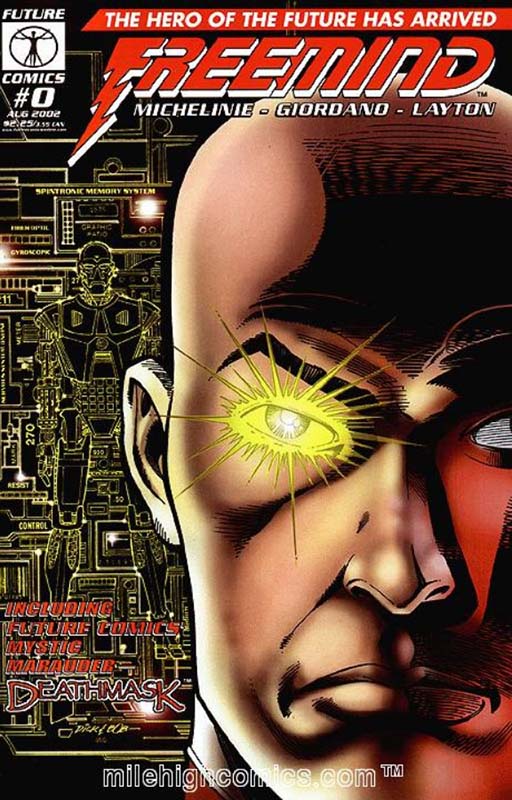
The main cover for Freemind #0 plays directly into the technological backdrop. If the company had more traction, it would definitely count as “iconic,” though the word is massively overused these days.
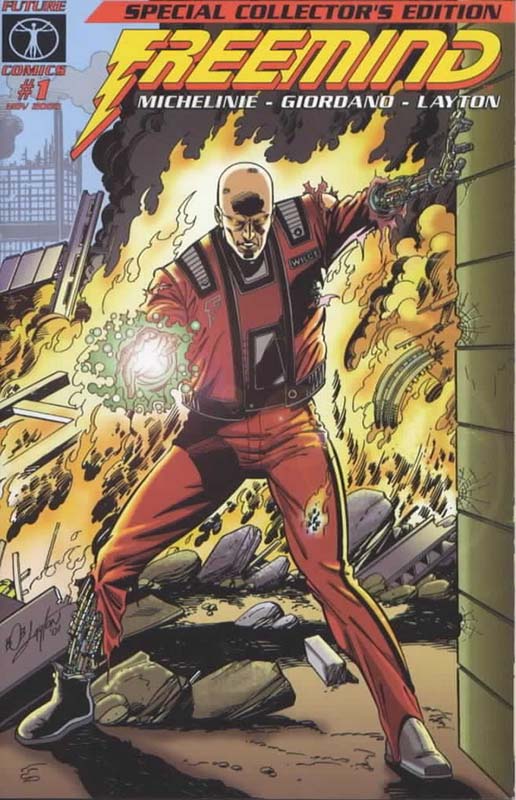
For the following issue, Freemind #1B is a fairly standard superhero riff with the strong central figure of Edison Wilde, who stands boldly amid obvious danger.
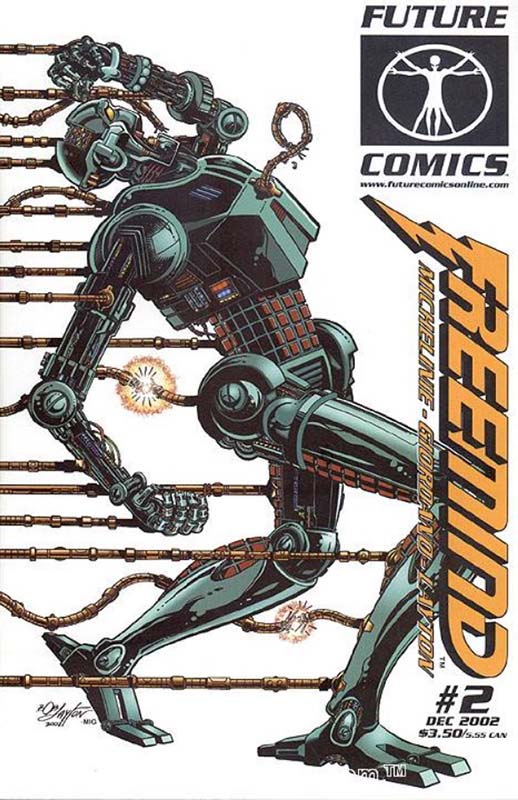
Freemind #2 is probably the least compelling of the set, but even it is different than anything else that was on the comic shop racks at the same time. This included running the logo vertically rather than horizontally.
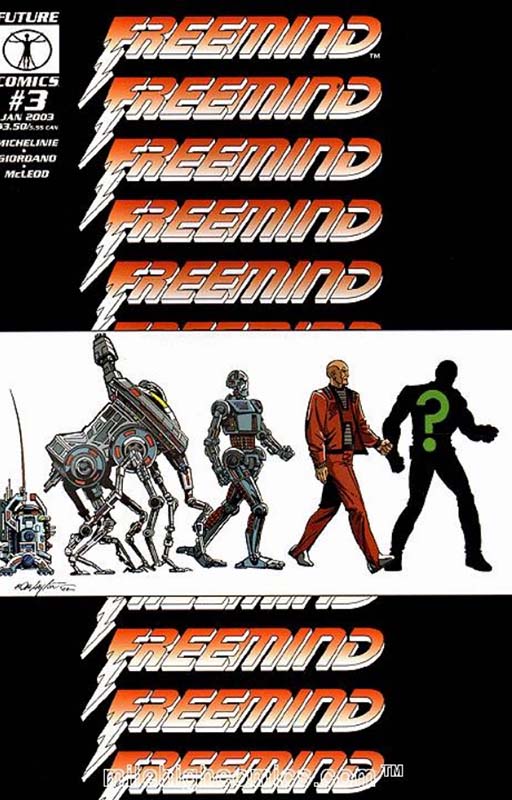
A mechanical take on the standard human evolutionary silhouette sequence highlights the cover for Freemind #3. Of note, it makes minimal use of the cover space. With roughly two thirds of the cover just a solid background color, the illustration takes the center of the piece. The repeated Freemind logo was also different than anything on the stands at the time.
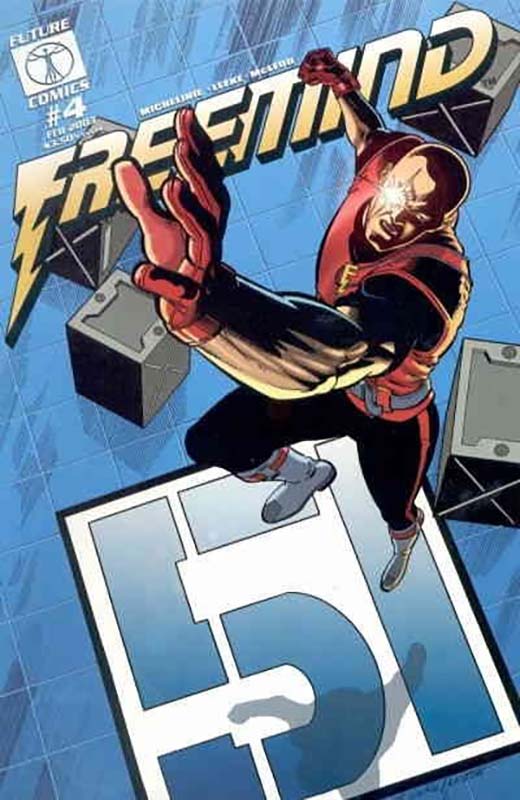
The logo and trade dress are angled as Edison Wilde flies upward, seemingly toward the reader, on the cover of Freemind #4 over a bold “51,” suggesting Area 51.
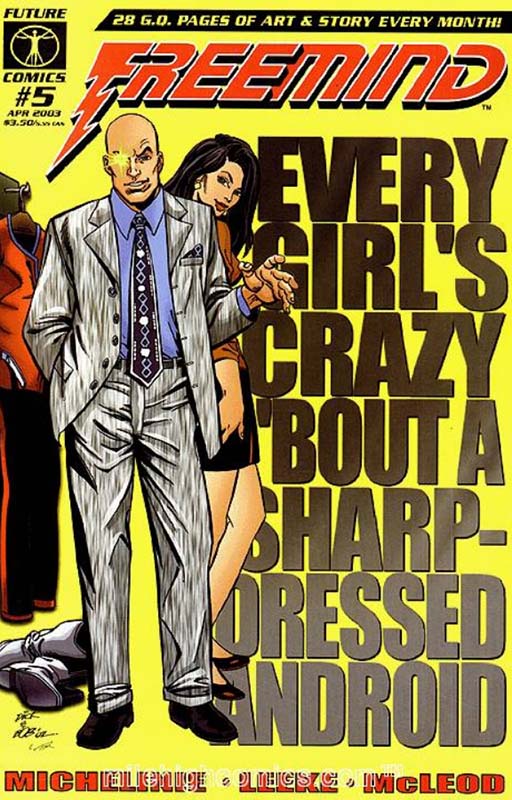
ZZ Top lyrics and a compelling use of text are the striking features of Freemind #5, the “Every Girl’s Crazy ‘Bout A Sharp-Dressed Android” cover. Again, a look at other covers on sale that month – or even that year – will find very few trying anything like this.
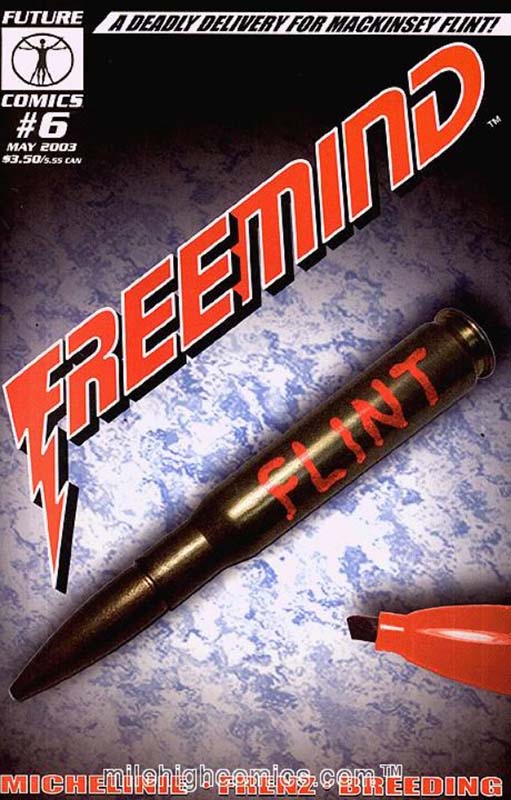
A single bullet with Flint’s name on it and another angled logo (but not the trade dress) get the spotlight on Freemind #6. By this point, it had become clear that the Future Comics team was putting a lot of thought into the cover designs.
Do all of them work equally? No. Are all of them intriguing? Yes, definitely.
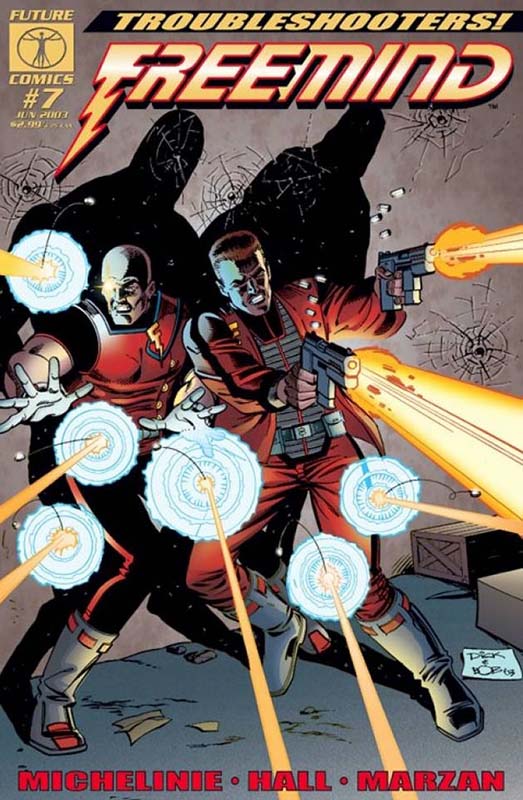
With bold action – gunfire both incoming and outgoing –Freemind #7 features Edison Wilde and another figure against a bullet-marked background. The muzzle blasts are used to great effect on what for many years would be the final issue of the series.
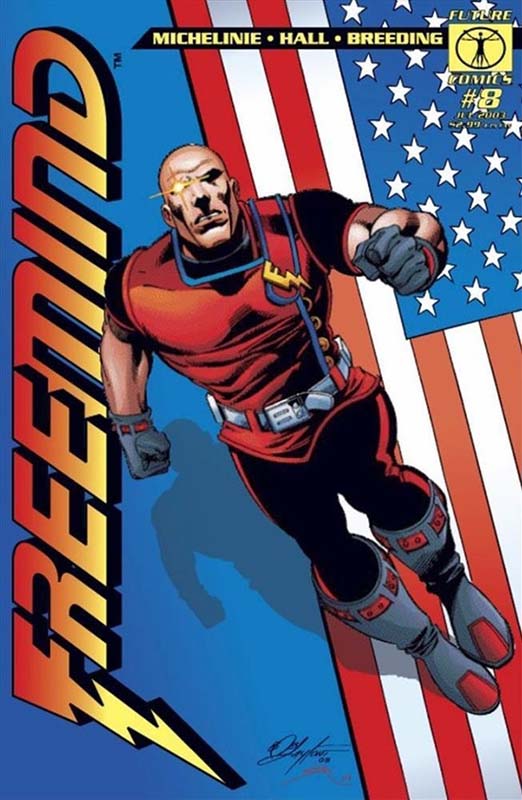
While the company released some titles digitally in 2012, it would be until 2018 before Freemind #8 saw print (along with along with Deathmask #4 and #5, Metallix #7, and Peacekeeper #1). With Edison Wilde front and center against a patriotic American flag background, it was a visually striking return for the character, albeit a short-lived one.
Success In Failure
While in hindsight they didn’t pay off in tremendous sales, these covers were still eye-catching and compelling. The fact that they’re worth discussing more than two decades later tells us something.
Layton, Giordano and their other contributors very quickly created, established, and promoted a brand identity for this series that fit the stories they were telling.
– J.C. Vaughn

Popular Topics
Overstreet Access Quick Links
COVER STORY: Freemind #0-8
Future Comics; $2.25 – $3.50 each
What makes the best comic book covers? It’s a great topic for debate. For us as individuals there is no wrong answer, of course. It’s purely subjective. But with a little thought, it is frequently possible to explain what it is about a particular image that grabs you. The best ones are the ones that make you stop and check out something you weren’t previously going to purchase – and in some cases, you even end up picking up a title you’ve never even heard of before.
The Concept
What if you were a brilliant scientist – Stephen Hawking-type brilliant – but, also like Hawking, you were in a body that betrayed you? What if you could turn the power of your mind toward finding a way out of – or at least around – your condition? That was the springboard for Freemind, the story of the inventive McKinsey Flint.
Paraplegic and using a wheelchair, he created technology that allowed him to transfer his conscience to a tough, powerful android body with fantastic powers. In the humanoid mechanical body, Flint uses the name Edison Wilde.
Both Flint and his technology, though, are targeted by nefarious elements, creating the action and adventure that framed the more thought-provoking elements of the series.
The Background
Freemind, originally published in single-issue format from August 2002 through June 2003, was Future Comics’ flagship title and its longest-running series. Created by writer David Michelinie, penciler Dick Giordano, and inker Bob Layton, the company’s founders along with publisher Skip Farrell.
Michelinie and Layton had, of course, teamed for a defining, epic run on Marvel’s Iron Man. Following two popular Hercules mini-series, among other projects, Layton was a co-founder of Valiant and served as editor after Jim Shooter was forced out. Giordano, in addition to his art skills, had been a highly influential figure at DC Comics. Together they spun up a company they hoped would capture lightning in a bottle a second time.
Tumult in the comic book market prevented Future Comics from hitting it big, and the company stopped publishing not too long after it started. That, however, didn’t stop them from putting out some truly dynamic, eye-catching covers.
The Covers
Freemind originally ran eight issues (#0-7), some of which featured very innovative cover designs. Take a look at them!
They’re certainly not all equal, but in each case they represent an attempt to innovate, catch the reader’s eye with something different, and convey a strong image. What’s really cool about the attempts at innovation is that the notion really connects well with the concept of the series.
The main cover for Freemind #0 plays directly into the technological backdrop. If the company had more traction, it would definitely count as “iconic,” though the word is massively overused these days.
For the following issue, Freemind #1B is a fairly standard superhero riff with the strong central figure of Edison Wilde, who stands boldly amid obvious danger.
Freemind #2 is probably the least compelling of the set, but even it is different than anything else that was on the comic shop racks at the same time. This included running the logo vertically rather than horizontally.
A mechanical take on the standard human evolutionary silhouette sequence highlights the cover for Freemind #3. Of note, it makes minimal use of the cover space. With roughly two thirds of the cover just a solid background color, the illustration takes the center of the piece. The repeated Freemind logo was also different than anything on the stands at the time.
The logo and trade dress are angled as Edison Wilde flies upward, seemingly toward the reader, on the cover of Freemind #4 over a bold “51,” suggesting Area 51.
ZZ Top lyrics and a compelling use of text are the striking features of Freemind #5, the “Every Girl’s Crazy ‘Bout A Sharp-Dressed Android” cover. Again, a look at other covers on sale that month – or even that year – will find very few trying anything like this.
A single bullet with Flint’s name on it and another angled logo (but not the trade dress) get the spotlight on Freemind #6. By this point, it had become clear that the Future Comics team was putting a lot of thought into the cover designs.
Do all of them work equally? No. Are all of them intriguing? Yes, definitely.
With bold action – gunfire both incoming and outgoing –Freemind #7 features Edison Wilde and another figure against a bullet-marked background. The muzzle blasts are used to great effect on what for many years would be the final issue of the series.
While the company released some titles digitally in 2012, it would be until 2018 before Freemind #8 saw print (along with along with Deathmask #4 and #5, Metallix #7, and Peacekeeper #1). With Edison Wilde front and center against a patriotic American flag background, it was a visually striking return for the character, albeit a short-lived one.
Success In Failure
While in hindsight they didn’t pay off in tremendous sales, these covers were still eye-catching and compelling. The fact that they’re worth discussing more than two decades later tells us something.
Layton, Giordano and their other contributors very quickly created, established, and promoted a brand identity for this series that fit the stories they were telling.
– J.C. Vaughn
Popular Topics
Overstreet Access Quick Links