



RETRO REVIEW: Lone Wolf and Cub #1
First Comics; $1.95
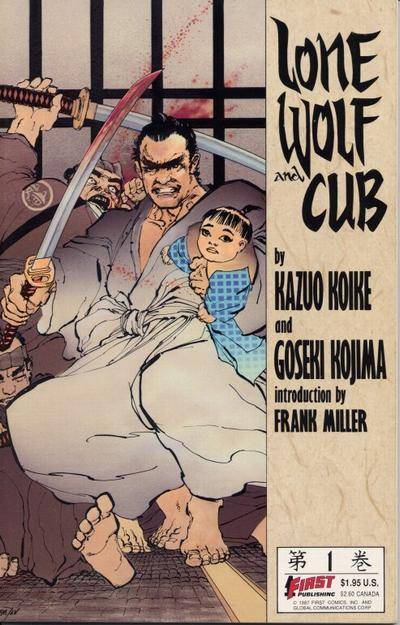
Written by Kazuo Koike and illustrated by Goseki Kojima, Lone Wolf and Cub was and remains one of the most influential manga series ever created. In addition to numerous translations around the world in comic book form, it spawned books, films, television shows, and video games.
It initially arrived in the US with Lone Wolf and Cub #1, cover dated May 1987, from First Comics. The first 12 issues featured covers by Frank Miller and Lynn Varley and an introduction by Miller. For those who read it and Miller's first run on Daredevil or the original Wolverine miniseries, the influence was immediately understandable.
Unlike subsequent US editions, this version was told in standard American, left to right reading order, which required some reformatting. That said, the stories still had tremendous impact.
The series tells the story of Ogami Ittō, the Shogun's executioner, whose wife was killed after giving birth to his son, Daigorō. Framed for disloyalty to the Shogun, he is ordered to take his own life as well as Daigorō's. He refuses and begins a one-man, one-baby war against those who betrayed him.
It's a bloody, harsh, and incredibly dynamic story steeped in Japanese history, codes of honor, action, and intrigue. Ogami, often with Daigorō in a baby cart or strapped to his back, fights his way from situation to situation in relentless fashion.
For many readers at the time of its release, Lone Wolf and Cub, Marvel's adaptation of Akira under the Epic banner, and Eclipse's offerings were the first prolonged exposure to manga. While they absolutely weren't in their pure Japanese right-to-left forms, they were certainly what paved the road for the awareness manga now has in the American market.
The square-bound format has stood up well over the years, and it's still relatively easy to find copies in good shape. The page counts are nowhere near as big as traditional manga, but they're substantially longer than traditional US comics. This gives reader a strong injection of the style, tone, and feel of the series right away.
Purists will want to stick with later versions, but for those looking for their first taste of the series can't do better than these back issues.
– J.C. Vaughn

Popular Topics
Overstreet Access Quick Links
RETRO REVIEW: Lone Wolf and Cub #1
First Comics; $1.95
Written by Kazuo Koike and illustrated by Goseki Kojima, Lone Wolf and Cub was and remains one of the most influential manga series ever created. In addition to numerous translations around the world in comic book form, it spawned books, films, television shows, and video games.
It initially arrived in the US with Lone Wolf and Cub #1, cover dated May 1987, from First Comics. The first 12 issues featured covers by Frank Miller and Lynn Varley and an introduction by Miller. For those who read it and Miller's first run on Daredevil or the original Wolverine miniseries, the influence was immediately understandable.
Unlike subsequent US editions, this version was told in standard American, left to right reading order, which required some reformatting. That said, the stories still had tremendous impact.
The series tells the story of Ogami Ittō, the Shogun's executioner, whose wife was killed after giving birth to his son, Daigorō. Framed for disloyalty to the Shogun, he is ordered to take his own life as well as Daigorō's. He refuses and begins a one-man, one-baby war against those who betrayed him.
It's a bloody, harsh, and incredibly dynamic story steeped in Japanese history, codes of honor, action, and intrigue. Ogami, often with Daigorō in a baby cart or strapped to his back, fights his way from situation to situation in relentless fashion.
For many readers at the time of its release, Lone Wolf and Cub, Marvel's adaptation of Akira under the Epic banner, and Eclipse's offerings were the first prolonged exposure to manga. While they absolutely weren't in their pure Japanese right-to-left forms, they were certainly what paved the road for the awareness manga now has in the American market.
The square-bound format has stood up well over the years, and it's still relatively easy to find copies in good shape. The page counts are nowhere near as big as traditional manga, but they're substantially longer than traditional US comics. This gives reader a strong injection of the style, tone, and feel of the series right away.
Purists will want to stick with later versions, but for those looking for their first taste of the series can't do better than these back issues.
– J.C. Vaughn
Popular Topics
Overstreet Access Quick Links